
TL;DR:
- Trauma physically reshapes the brain, increasing vulnerability to addiction through stress and emotional dysregulation.
- Self-medication with substances reinforces the trauma-related brain changes, creating a vicious cycle.
- Effective recovery requires trauma-informed, phased treatment addressing underlying trauma and its psychological effects.
Addiction is rarely just about a substance. 46% of PTSD patients also meet criteria for a substance use disorder, and 75% of people in addiction treatment report a significant trauma history. Yet most people still think of addiction as a matter of willpower or poor choices. That framing misses something critical: trauma physically reshapes the brain, alters stress responses, and creates the very conditions that make substances feel like relief. This guide breaks down the science connecting trauma and addiction, explains the real-world patterns that drive this cycle, and outlines evidence-based steps that actually help.
Table of Contents
- The science: How trauma shapes the brain and rewires behavior
- From trauma to addiction: Common pathways and patterns
- Complex trauma, CPTSD, and the challenge of dual diagnosis
- Trauma-informed care and evidence-based solutions for recovery
- Why breaking the trauma-addiction cycle takes more than treatment
- Ready for help? Trauma-informed recovery in Los Angeles
- Frequently asked questions
Key Takeaways
| Point | Details |
|---|---|
| Trauma changes the brain | Stress, negative emotions, and altered brain circuits make addiction more likely after trauma. |
| ACEs multiply addiction risk | Experiencing multiple childhood trauma exposures sharply increases substance use disorder risk. |
| Integrated care gets better results | Trauma-informed therapies and dual-diagnosis strategies improve recovery outcomes for PTSD, CPTSD, and addiction. |
| Family support breaks cycles | Loved ones play a crucial role in interrupting trauma-addiction cycles and promoting healing. |
| Los Angeles offers solutions | Local addiction centers provide evidence-based, trauma-informed care for teens, adults, and families. |
The science: How trauma shapes the brain and rewires behavior
Trauma does not just leave emotional scars. It changes how the brain is built and how it functions. Understanding these changes helps explain why people who have experienced trauma are significantly more likely to develop a substance use disorder.
When a person experiences trauma, the body’s stress system goes into overdrive. Cortisol, the primary stress hormone, floods the brain. Over time, chronic stress exposure activates the brain reward and stress circuits, specifically the dynorphin and kappa opioid receptor (KOR) system. This system, when activated, produces feelings of dysphoria, anxiety, and emotional pain. Substances like alcohol, opioids, or stimulants can temporarily suppress this system, which is why they feel so effective as short-term relief.
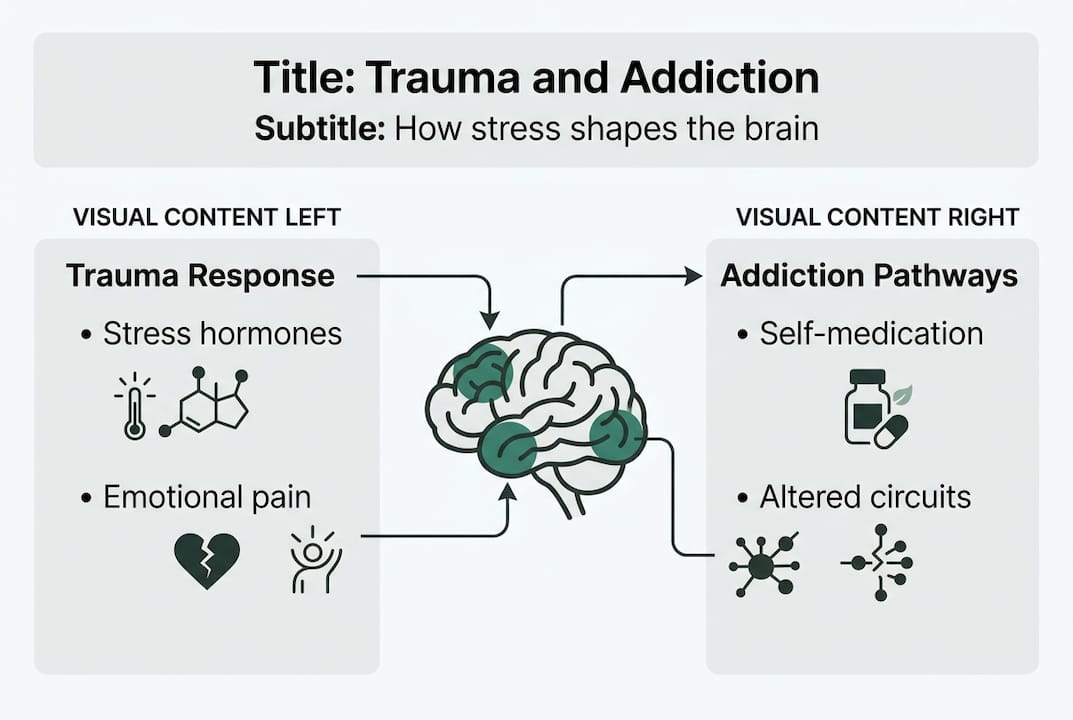
Childhood trauma has an even deeper impact. Childhood adversity alters the development of the amygdala (which processes fear), the hippocampus (which manages memory and context), and the prefrontal cortex (which regulates impulse control and decision-making). When these regions are disrupted early in life, the brain becomes more reactive to stress and less capable of managing it without external help.
Trauma also affects genes through a process called epigenetics. Stress can switch certain genes on or off, making the brain more sensitive to anxiety, emotional pain, and the rewarding effects of substances. These changes can persist for years and even influence how future generations respond to stress.
75% of people with SUD report a history of trauma, which is not a coincidence. It reflects how deeply trauma is wired into the biology of addiction.
| Pathway | Neurobiological | Psychological |
|---|---|---|
| Primary driver | Brain structure changes, KOR activation | Emotional avoidance, learned helplessness |
| Key brain areas | Amygdala, hippocampus, prefrontal cortex | Reward system, stress response |
| Substance role | Suppresses dysphoria and cortisol spikes | Numbs emotional pain and intrusive thoughts |
| Long-term effect | Altered stress sensitivity, cravings | Negative self-belief, avoidance behaviors |
Key neurobiological effects of trauma include:
- Overactive fear response via the amygdala
- Impaired emotional regulation from prefrontal cortex damage
- Disrupted memory processing in the hippocampus
- Heightened sensitivity to stress and substance effects through epigenetic changes
- Activation of the KOR system, producing chronic negative emotional states
From trauma to addiction: Common pathways and patterns
Understanding the scientific basis, let’s look at the practical paths and real-life cycles that show how trauma can drive addiction.
The most common route is self-medication. When trauma creates persistent anxiety, emotional numbness, or intrusive memories, substances offer a fast and accessible form of relief. Alcohol slows the nervous system. Opioids blunt emotional pain. Stimulants can temporarily restore a sense of energy and control. The problem is that each use reinforces the brain’s reliance on the substance, making the underlying trauma harder to face without it.

Post-traumatic stress disorder (PTSD) plays a central role in this cycle. 46% of PTSD patients develop a substance use disorder, and among youth, 60% with PTSD develop substance problems. PTSD heightens sensitivity to everyday stressors, making substances feel even more necessary as a coping tool. This creates a reinforcing loop: trauma triggers PTSD, PTSD drives substance use, and substance use worsens PTSD symptoms over time.
Adverse childhood experiences (ACEs) follow a clear dose-response pattern. The more ACEs a person has, the higher their risk. 5 or more ACEs increase the risk of substance use disorder by 7 to 10 times. Early trauma also predicts earlier substance initiation, which itself is a strong predictor of more severe addiction in adulthood.
PTSD develops in approximately 16% of trauma-exposed youth, making early identification especially important for teens in Los Angeles County.
Common pathways from trauma to addiction:
- Trauma exposure creates chronic stress and emotional dysregulation
- Untreated symptoms lead to self-medication with alcohol or drugs
- Substance use provides temporary relief, reinforcing continued use
- Tolerance builds, requiring more of the substance for the same effect
- Withdrawal and cravings deepen reliance, making abstinence feel impossible
- Trauma symptoms worsen, restarting the cycle
Pro Tip: If you or someone you love has experienced multiple ACEs, a substance use assessment can identify risks early and connect you with trauma-informed care before the cycle deepens.
“ACEs increase substance use disorder risk by up to 10 times for those with five or more exposures. This is not about weakness. It is about biology meeting circumstance.”
Complex trauma, CPTSD, and the challenge of dual diagnosis
As we see different pathways from trauma to addiction, it is essential to highlight the unique challenges of complex trauma and dual diagnosis.
Most people have heard of PTSD, but complex PTSD (CPTSD) is less understood and, in addiction settings, far more common. PTSD typically follows a single traumatic event such as an accident or assault. CPTSD develops from prolonged, repeated trauma, such as childhood abuse, domestic violence, or neglect. The difference matters because CPTSD affects not just fear responses but a person’s entire sense of self.
CPTSD is present in 35% of people in substance use disorder settings, compared to just 6% with standard PTSD. People with CPTSD struggle with affect dysregulation (intense, uncontrollable emotional states) and a deeply negative self-concept, both of which drive psychological dependence on substances.
| Feature | PTSD | CPTSD |
|---|---|---|
| Trauma type | Single event | Prolonged or repeated |
| Core symptoms | Flashbacks, hypervigilance, avoidance | All PTSD symptoms plus identity disruption, shame |
| Self-concept | Mostly intact | Severely distorted, chronic shame |
| SUD prevalence | 6% in treatment settings | 35% in treatment settings |
| Treatment complexity | Moderate | High, requires phased approach |
Dual diagnosis refers to the co-occurrence of a mental health condition (like PTSD or CPTSD) and a substance use disorder. Treating only one without addressing the other dramatically reduces recovery outcomes. Trauma-focused therapies are superior for PTSD reduction, and reductions in PTSD symptoms directly improve substance use outcomes.
Key features of CPTSD that complicate addiction recovery:
- Persistent shame and self-blame that fuel continued substance use
- Emotional dysregulation that makes withdrawal feel unbearable
- Distorted self-identity that undermines motivation for recovery
- Difficulty trusting treatment providers due to past relational trauma
- Higher rates of suicidal ideation and self-harm behaviors
Understanding the PTSD and CPTSD differences is the first step in getting the right kind of help. Holistic recovery for dual diagnosis addresses both conditions together, and dual diagnosis recovery strategies can be tailored to individual needs.
Pro Tip: When seeking treatment, always ask whether the program screens for chronic trauma and addresses negative self-concept, not just substance use behaviors.
Trauma-informed care and evidence-based solutions for recovery
With a clear understanding of the link and the nuances, let’s focus on how trauma-informed care and evidence-based therapies can help.
Trauma-informed care starts with screening. Before any treatment plan is built, identifying whether trauma is present allows providers to personalize care and avoid re-traumatizing clients through poorly matched interventions. SAMHSA-recommended approaches integrate trauma screening, phased care, and evidence-based therapies like cognitive behavioral therapy (CBT), dialectical behavior therapy (DBT), and eye movement desensitization and reprocessing (EMDR).
Phased care is the standard of practice. The first phase focuses on stabilization: building safety, reducing acute symptoms, and establishing trust. The second phase involves trauma processing, where the person works through traumatic memories in a controlled, supported environment. This sequence prevents overwhelming clients before they have the coping tools to handle it.
CBT for addiction helps clients identify and change thought patterns that drive substance use. DBT adds skills for emotional regulation and distress tolerance, which are especially useful for CPTSD. EMDR targets traumatic memories directly, reducing their emotional charge without requiring clients to talk through them in detail.
Family involvement is a critical and often underutilized part of recovery. Loved ones who understand the trauma-addiction connection can break intergenerational cycles rather than unknowingly reinforce them. Family therapy sessions help everyone involved learn healthier communication patterns and recognize trauma triggers.
| Recovery action | Who it helps | When to start |
|---|---|---|
| Trauma screening | Everyone entering treatment | Immediately upon intake |
| Stabilization phase | Those in acute distress | First weeks of treatment |
| CBT or DBT therapy | Adults and teens with SUD and trauma | After stabilization |
| EMDR | Those with specific traumatic memories | Mid-to-late treatment phase |
| Family therapy | Loved ones and clients together | Ongoing throughout treatment |
| Aftercare planning | All clients | Before program completion |
Steps to access trauma-informed care in Los Angeles:
- Request a trauma screening at your first intake appointment
- Ask specifically about personalized addiction care that addresses co-occurring trauma
- Involve a trusted family member in the treatment planning process
- Build a daily routine using self-care tips for recovery to support emotional stability
- Commit to aftercare services to maintain gains after intensive treatment ends
Why breaking the trauma-addiction cycle takes more than treatment
Bringing it all together, here is our take on what really breaks the trauma and addiction cycle.
At Glendora Recovery Center, we have seen what happens when treatment focuses only on stopping substance use without addressing the trauma underneath. Clients complete programs, return to the same environments, and relapse within months. Not because they failed, but because the root was never treated.
Real recovery means healing the origin, not just managing the symptoms. That requires trauma-informed therapy, yes, but also community awareness, family education, and sustained support over time. Recognizing the trauma-to-self-medication cycle is something families must do alongside their loved ones, not just clinicians behind closed doors.
The uncomfortable truth is that willpower alone cannot override a brain that has been neurologically altered by trauma. Policy, access to care, and family involvement matter just as much as individual effort. Mental health strategies that address both trauma and addiction together consistently outperform those that treat them separately. Lasting recovery is not a destination. It is an ongoing process of healing the whole person.
Ready for help? Trauma-informed recovery in Los Angeles
If you or someone you love is caught in the trauma-addiction cycle, you do not have to navigate it alone. Glendora Recovery Center offers addiction treatment options specifically designed to address trauma, PTSD, CPTSD, and co-occurring substance use disorders. Our comprehensive treatment explained approach includes Partial Hospitalization Programs, Intensive Outpatient Programs, and telehealth options for teens and adults across Los Angeles County. We also provide mental health support and family therapy to help break intergenerational cycles. Reach out today to speak with our team and take the first step toward recovery that actually lasts.
Frequently asked questions
What is trauma-informed addiction treatment?
Trauma-informed addiction treatment integrates trauma screening, phased care, and therapies like CBT, DBT, or EMDR to address both trauma and substance use together. SAMHSA recommends this integrated approach as the standard for effective SUD treatment.
How do adverse childhood experiences (ACEs) increase risk for addiction?
ACEs disrupt brain development and stress responses, and 5 or more ACEs increase the risk of substance use disorder by 7 to 10 times through a clear dose-response relationship.
Can addiction cause trauma, or is it only trauma causing addiction?
The relationship is bidirectional. Substance use increases trauma risk as well as being caused by it, meaning addiction and trauma can each worsen the other over time.
What’s the difference between PTSD and complex PTSD (CPTSD) in addiction?
CPTSD involves chronic self-concept disruption and affect dysregulation, making it more prevalent and harder to treat than standard PTSD in addiction settings, requiring more tailored therapeutic approaches.
How can families and loved ones help break the trauma-addiction cycle?
Families can advocate for trauma-informed care, participate in therapy, and recognize self-medication cycles to prevent intergenerational transmission of trauma and addiction.
Recommended
- Why addiction is a disease: brain science & recovery | Glendora Recovery Center
- How mental health drives lasting recovery: evidence and strategies | Glendora Recovery Center
- Understanding Addiction Relapse: Causes, Myths & Recovery | Glendora Recovery Center
- Psychology’s role in addiction recovery: Los Angeles 2026 | Glendora Recovery Center
- Childhood Trauma Explained: Complete Guide for Families – Mastering Conflict