
TL;DR:
- Mental health and addiction are interconnected and must be treated simultaneously for lasting recovery.
- Integrated care, combining therapies, medication, and peer support, improves outcomes over sequential treatment.
- Addressing trauma and co-occurring disorders is crucial, especially in high-risk populations like LA County residents.
Addiction and mental health are not two separate battles. They are, in almost every clinical sense, the same fight. Many people in Los Angeles County enter recovery focused entirely on stopping substance use, unaware that an untreated anxiety disorder, unresolved trauma, or depression is quietly fueling the cycle. SAMHSA’s 2024 data shows that co-occurring mental health and substance use disorders are far more common than most people realize. Understanding how mental health shapes recovery is not just helpful. It is essential if you want results that last.
Table of Contents
- Mental health and addiction: Two sides of the same coin
- Why integrated treatment works best
- Addressing trauma and unique risks for LA County residents
- Building a foundation for lasting recovery
- Expert perspective: What most people get wrong about mental health in recovery
- Ready for support? Connecting to proven mental health and recovery care in LA
- Frequently asked questions
Key Takeaways
| Point | Details |
|---|---|
| Mental health drives recovery | Treating mental health and addiction together leads to stronger, longer-lasting results. |
| Integrated care outperforms | Simultaneous therapy for both conditions lowers relapse and improves well-being. |
| Trauma must be addressed | Addressing trauma is essential for real progress in both mental health and substance use recovery. |
| Ongoing support matters | Recovery is not a one-time fix and requires continuous mental health support and resources. |
Mental health and addiction: Two sides of the same coin
The idea that you can treat addiction without addressing mental health is one of the most persistent myths in recovery. Science tells a different story. Mental health conditions and substance use disorders are deeply connected, often feeding each other in a cycle that becomes harder to break the longer it goes unaddressed.
Many people begin using substances to manage emotional pain. Someone with untreated depression may drink to feel something. Someone with severe anxiety may use opioids to quiet the noise in their mind. This is called the self-medication model, and research confirms that neurological changes from prolonged substance use then worsen the very mental health conditions the person was trying to escape. The brain’s reward and stress systems become dysregulated, making emotional stability harder to achieve without substances.
In Los Angeles County, nearly 1 in 5 adults experience mental health challenges each year, from depression to anxiety-related conditions like OCD that often respond to specialized OCD treatment delivered alongside addiction care. The overlap with substance use is significant. Nationally, co-occurring disorders affect millions, and LA County reflects those numbers closely given its population size and diversity of risk factors.
| Condition | % with co-occurring SUD | % with co-occurring mental health disorder |
|---|---|---|
| Major depressive disorder | ~30% | N/A |
| Anxiety disorders | ~20% | N/A |
| Substance use disorder | N/A | ~50% |
“Treating addiction without treating the underlying mental health condition is like patching a leak without fixing the pipe. The pressure will find another way out.”
Common misconceptions still push people toward sequential treatment, meaning they try to get sober first and then address mental health later. But this approach consistently underperforms. Here is why it fails:
- Mental health symptoms intensify during early withdrawal, making relapse more likely
- Untreated trauma or depression creates constant emotional triggers
- Without coping tools from mental health therapy, stress management is nearly impossible
- The brain needs simultaneous support to rebuild healthy function
For a closer look at how specific conditions like PTSD intersect with addiction, the PTSD and addiction guide from Glendora Recovery Center walks through the mechanisms in detail. LA County also offers enhanced care management programs that recognize this connection and coordinate care accordingly.
Why integrated treatment works best
Having established how these conditions are linked, the next question is what actually works. The answer, supported by growing evidence, is integrated treatment. This means addressing mental health and substance use disorders at the same time, within a coordinated care plan, rather than handling them one after the other.
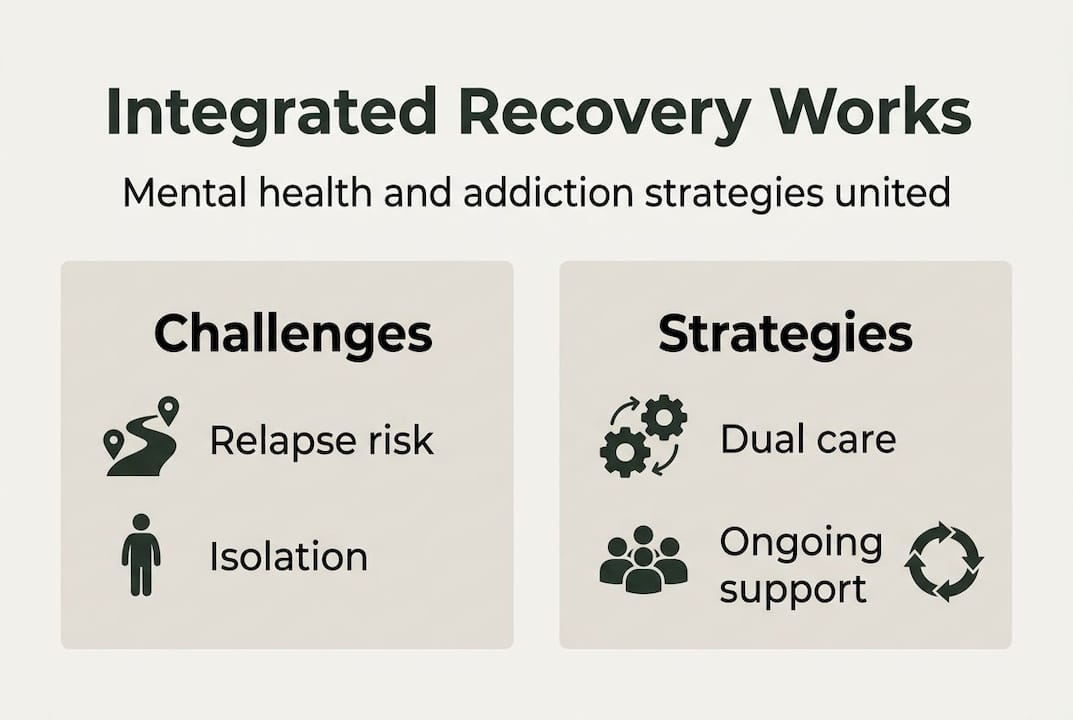
Dual diagnosis treatment brings together therapists, addiction counselors, and medical providers who communicate and collaborate. The result is a plan that treats the whole person, not just the symptom that showed up first.
Here is what integrated treatment typically includes:
- A thorough individualized assessment to identify all co-occurring conditions
- Evidence-based therapies such as Cognitive Behavioral Therapy (CBT), Dialectical Behavior Therapy (DBT), and EMDR running in parallel
- Medication management for both psychiatric and addiction-related needs
- Peer support and community engagement built into the care plan
- Regular reassessment and plan adjustment as recovery progresses
| Approach | Relapse rate | Mental health outcomes | Engagement |
|---|---|---|---|
| Isolated (one at a time) | Higher | Slower improvement | Lower |
| Integrated (simultaneous) | Lower | Faster stabilization | Higher |
LA County has invested in models like the Transition Age Youth (TAY) program, which integrates mental health and SUD services for young adults aged 16 to 25. These programs have been linked to measurable reductions in overdose deaths among this vulnerable group. The benefits of dual diagnosis treatment extend across all age groups, but they are especially pronounced in populations that have historically fallen through the cracks of siloed systems.
Pro Tip: When evaluating any treatment program, ask directly whether mental health and addiction services are delivered by the same coordinated team. If the answer is no, the program may not be equipped to address co-occurring disorders effectively.
NIDA’s strategic framework reinforces that integrated care is not just a trend. It is the direction the entire field is moving because the evidence is clear. For teens and young adults in LA County, rehab programs that build in mental health support from day one produce far better outcomes than those that treat addiction in isolation.
Addressing trauma and unique risks for LA County residents
Understanding treatment types is important, but it is equally important to recognize how trauma and specific LA County risk factors shape the path to recovery. Los Angeles is a city of extremes. Wealth and poverty exist blocks apart. Homelessness, justice involvement, and youth instability create conditions where trauma is not the exception. It is often the rule.
Trauma sits at the center of most co-occurring disorder cases. Whether it is childhood abuse, community violence, housing instability, or loss, unresolved trauma keeps the nervous system in a state of chronic stress. That stress is a powerful driver of substance use. Trauma-focused therapies like EMDR and CBT have been shown in meta-analyses to reduce both PTSD symptoms and substance use disorder severity at the same time, making them especially valuable in integrated care settings.
“Trauma is not a character flaw. It is a wound that, when left untreated, reshapes how the brain responds to everything, including the pull toward substances.”
High-risk groups in LA County include:
- People experiencing homelessness, who face the highest overdose rates in the region
- Transition age youth navigating unstable housing and family systems
- Postpartum individuals dealing with perinatal mental health challenges
- Veterans managing service-related trauma and substance use
- Justice-involved individuals cycling through systems without coordinated care
LA County’s Department of Mental Health and Substance Abuse Prevention and Control offer outpatient services specifically designed for these underserved populations. These programs recognize that a one-size-fits-all approach fails the people who need help most.
Pro Tip: If you or someone you care about has experienced trauma, make sure any treatment program you consider includes trauma-informed care as a core component, not an afterthought.
For a deeper understanding of how trauma and addiction interact, the trauma and addiction resource from Glendora Recovery Center is a strong starting point. You can also explore why mental health matters in recovery and practical recovery self-care tips that support day-to-day stability.
Building a foundation for lasting recovery
With risk factors and treatment pathways in mind, here are practical steps for building a solid recovery foundation. Recovery is not a single event. It is an ongoing process that requires consistent support, self-advocacy, and the right combination of professional and community resources.
Here are the core steps for getting started:
- Get a thorough assessment that screens for both mental health and substance use disorders
- Work with providers to build an individualized plan that addresses both conditions simultaneously
- Engage in evidence-based therapies and, where appropriate, medication management
- Connect with peer support groups and community networks in LA County
- Maintain ongoing outpatient care even after initial treatment ends
Outpatient mental health services are especially valuable for sustaining progress after a higher level of care. They provide structure without requiring full-time residential commitment, which makes them accessible for people managing work, school, or family responsibilities.
Key supports to keep in mind:
- Enhanced Care Management through LA County coordinates medical, mental health, and SUD services for high-need individuals
- Peer support specialists who have lived experience with recovery offer a kind of connection that clinical staff alone cannot provide
- Family therapy helps repair relationships and builds a home environment that supports long-term sobriety
- Telehealth options make it possible to access care without transportation barriers
SAMHSA and NIDA both recommend integrated, ongoing, data-driven care as the standard for best recovery outcomes. That means treatment should not stop when the acute phase ends. The dual diagnosis recovery guide from Glendora Recovery Center outlines how to sustain momentum after initial treatment. For those exploring what comprehensive mental health treatment looks like in practice, the options in LA County are more accessible than many people realize. LA County’s enhanced care management program is a good first call for anyone unsure where to begin.

Expert perspective: What most people get wrong about mental health in recovery
After covering the steps, it is worth addressing what decades of evidence and clinical experience have revealed about mental health’s real role in recovery. The biggest mistake we see is not a lack of effort. It is a fundamental misunderstanding of sequence. This connects closely with a step-by-step detox guide, which covers the topic in more depth.
People believe they need to get clean first, then fix their mental health. But the data does not support that order. Concurrent care, where both issues are treated at the same time, consistently outperforms sequential care. The brain does not wait for one problem to be solved before the other starts causing damage. Understanding evidence-based care at Glendora can make the road ahead feel more manageable.
The second thing most people underestimate is the invisible weight of unresolved trauma. It does not announce itself. It shows up as irritability, sleeplessness, impulsive decisions, and cravings that seem to come from nowhere. Integrated, trauma-aware therapy is not optional for most people in recovery. It is foundational.
We also want to challenge the idea that mental health treatment is somehow separate from “real” recovery work. It is the same work. Understanding why mental health matters in recovery is not a detour from sobriety. It is the most direct path to it.
Ready for support? Connecting to proven mental health and recovery care in LA
If this article has made one thing clear, it is that mental health and addiction recovery are inseparable. Glendora Recovery Center offers integrated addiction treatment designed specifically for adults and teens in Los Angeles County who are navigating co-occurring disorders. From Partial Hospitalization Programs to Intensive Outpatient Programs and telehealth options, our team builds individualized plans that address both mental health and substance use from day one. Our dual diagnosis treatment approach is grounded in evidence and delivered with compassion. You do not have to figure this out alone. Reach out to us for a confidential conversation about your next step.
Frequently asked questions
Why is mental health so important to addiction recovery?
Mental health conditions are strongly linked to substance use and relapse, so treating both at the same time increases the odds of lasting recovery. Co-occurring disorders are the norm, not the exception, among people seeking addiction treatment.
What is integrated (dual diagnosis) treatment?
Integrated treatment means mental health and addiction issues are treated together with a customized plan and coordinated therapies. Dual diagnosis treatment addresses both issues simultaneously rather than one after the other.
Can trauma-focused therapy help with both PTSD and substance use?
Yes, research shows trauma-focused therapy reduces both PTSD symptoms and substance use disorder severity. Meta-analyses confirm that PTSD reduction directly mediates improvement in substance use outcomes.
What programs are available in Los Angeles for dual diagnosis?
LA County offers Enhanced Care Management, TAY programs, and outpatient services that focus on mental health and substance use treatment together. The Enhanced Care Management program is one of the most accessible entry points for coordinated dual diagnosis care.
Can you recover without professional help if you have co-occurring mental health and addiction issues?
Some people do recover without formal help, but evidence shows professional integrated care leads to better and longer-lasting results. Neurological research confirms that the brain changes caused by co-occurring disorders typically require structured, coordinated intervention to heal effectively.
Recommended
- Why mindfulness matters in recovery: 2026 guide | Glendora Recovery Center
- Why mental health matters in recovery: a 2026 guide | Glendora Recovery Center
- Effective self-care tips for recovery to improve well-being | Glendora Recovery Center
- Why Ongoing Recovery Matters in Addiction Treatment | Glendora Recovery Center
- Top trauma healing tips: 7 evidence-based paths to recovery