
TL;DR:
- Clarifying individual needs and goals is essential for choosing appropriate addiction treatment levels.
- Programs vary from outpatient to residential, matching severity, stability, and co-occurring conditions.
- Verify facility credentials, evidence-based practices, insurance coverage, and local LA County resources for quality care.
Picture this: you’re sitting at your kitchen table, searching through dozens of addiction treatment programs in Los Angeles County, and every website looks the same. You’re worried about picking the wrong one, especially if you or your loved one is also dealing with depression, anxiety, or trauma on top of substance use. That feeling of overwhelm is real, and it’s more common than you might think. This guide walks you through each step of the process, from clarifying your needs to verifying insurance and quality, so you can move from confusion to confident action.
Table of Contents
- Understanding your needs and goals
- Compare levels of care: outpatient, IOP, PHP, and residential
- How to evaluate treatment quality: staff, credentials, and best practices
- How to verify access: insurance, cost, and LA County resources
- What most guides miss about treatment choices in LA County
- Get expert help choosing your treatment program
- FAQ
Key Takeaways
| Point | Details |
|---|---|
| Match care to your needs | Start by assessing your goals, severity, and support to make the right treatment choice. |
| Check program quality | Look for accredited centers with licensed staff and evidence-based care for better outcomes. |
| Verify insurance and access | Confirm Medi-Cal, private insurance, or public directories to guarantee coverage and avoid delays. |
| Use local resources | LA County offers tools like the SBAT directory and a ‘no wrong door’ policy for timely help. |
Understanding your needs and goals
Now that you’re ready to start, the first and often most overlooked step is to clarify exactly what you or your loved one needs from treatment. Without this foundation, it’s easy to choose a program that looks good on paper but doesn’t actually fit your situation.
Start by defining your primary goals. Are you focused on achieving sobriety, managing a co-occurring mental health condition, rebuilding relationships, or regaining stability at work or school? Your answer shapes everything that follows. 20.4 million US adults live with both a mental health and substance use disorder, and for this group, the level of care depends heavily on the severity of both conditions.
Next, assess how severe the substance use has become. Ask yourself or your loved one:
- Has use escalated despite serious consequences at home, work, or in relationships?
- Has there been a prior attempt at treatment or a relapse after recovery?
- Are withdrawal symptoms present when use stops?
- Is there a co-occurring mental health diagnosis such as depression, bipolar disorder, or post-traumatic stress disorder?
- Is there stable housing, employment, or a supportive home environment?
These answers directly influence which levels of care are appropriate. Someone with a mild substance use disorder, a stable home, and no co-occurring diagnoses may do well in standard outpatient care. Someone with multiple relapses and untreated trauma likely needs more intensive support.
Also consider what your daily life looks like. Work schedules, childcare, school commitments, and transportation all affect which programs are realistic. A program that requires daily attendance may not be feasible for a single parent working full time. Understanding the full treatment continuum helps you see where a given program fits within the broader recovery journey.
If you’re genuinely unsure where to start, a primary care physician or a licensed counselor can conduct an initial assessment and point you toward appropriate resources. You don’t need to have all the answers on your own.
Pro tip: When evaluating your situation, bring a trusted friend or family member. A second perspective often catches details you might miss when you’re emotionally close to the situation.
Compare levels of care: outpatient, IOP, PHP, and residential
With personal needs and priorities in mind, next you’ll look at the different program models and how they align with what you’re seeking.
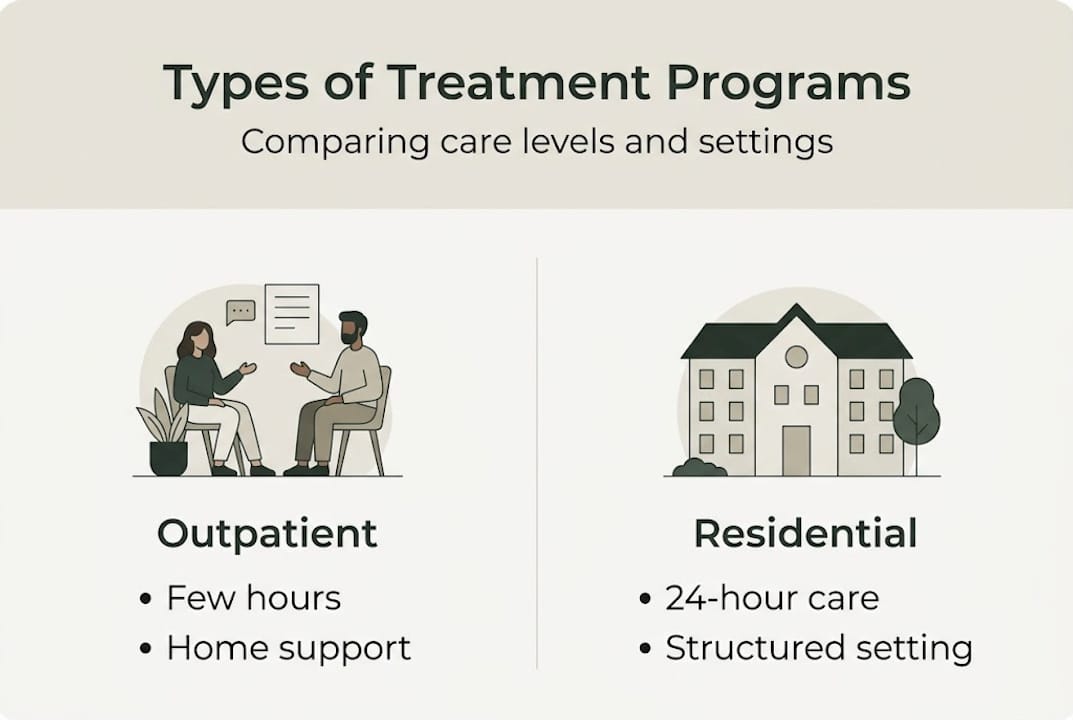
Addiction treatment isn’t one-size-fits-all. Programs vary significantly in structure, hours, supervision, and cost. Here’s a clear breakdown:
| Level of care | Hours per week | Structure | Best for | Cost range (est.) |
|---|---|---|---|---|
| Standard outpatient | 2 to 4 hrs | Low, flexible | mild cases, stable home | Low |
| IOP (intensive outpatient) | 9 to 19 hrs | Medium | outpatient treatment benefits for moderate cases | Medium |
| PHP (partial hospitalization) | 20 to 30 hrs | High, day programming | Step-down from residential | Medium-high |
| residential vs outpatient care | 24/7 | Maximum | Complex, severe, or dual diagnosis | High |
Here’s how to match your situation to a care level:
- Standard outpatient suits individuals with mild substance use, a stable living environment, and strong social support. Sessions are typically a few hours per week.
- IOP works well for those who need more support than standard outpatient but still have a safe place to live and can manage daily responsibilities.
- PHP is often recommended after residential care or for those with moderate to severe disorders who don’t require overnight supervision.
- residential is the right choice when someone has a severe disorder, lacks a stable home, or has a history of repeated relapses with complex co-occurring needs.
The key factors to weigh are stability at home, severity of use, history of relapse, and the presence of a co-occurring mental health condition. Someone stepping down from detox, for example, may need residential before moving to PHP and then IOP over time.
Pro tip: Don’t automatically choose the most intensive setting because it seems safer. The best program is the one that matches your actual needs, not the one that sounds most rigorous.
How to evaluate treatment quality: staff, credentials, and best practices
Once you recognize the right level of care, you need to make sure the programs you consider actually deliver quality, evidence-based treatment.
Not all treatment programs are equal. Some facilities have highly trained clinical teams and proven methods. Others rely on outdated approaches or lack essential credentials. Licensed staff and proven methods are non-negotiable for safe recovery.
Here are the key standards to check and questions to ask:
| Quality standard | Question to ask the facility |
|---|---|
| Staff licensure | Are your therapists licensed (MFT, LPC, or equivalent)? |
| Medical oversight | Is there a board-certified physician or psychiatrist on staff? |
| Program accreditation | Are you accredited by the Joint Commission or accreditation standards? |
| Evidence-based practices | Do you use CBT, motivational interviewing, or integrated dual diagnosis care? |
| Treatment planning | Is each client’s treatment plan individualized and regularly updated? |
Accreditation from organizations like the Joint Commission or the Commission on the accreditation of rehabilitation facilities (known as CBT for addiction) signals that a program meets rigorous national standards.

Evidence-based practices are another critical marker. Look for cognitive behavioral therapy (CBT), motivational interviewing (MI), and integrated care models that address both addiction and mental health at the same time. These methods have substantial research behind them and produce better long-term outcomes than generic talk therapy alone.
Watch for red flags such as vague answers about clinical methods, staff without verifiable credentials, pressure to commit quickly, and promises of guaranteed recovery. Quality programs welcome questions and give straightforward, transparent answers.
Research also shows that music therapy and structured creative programming can support mental health during recovery, and some quality programs incorporate these alongside core clinical treatments.
How to verify access: insurance, cost, and LA County resources
After finding credible programs that fit your needs, ensure you can actually access care both financially and logistically.
Cost is one of the most common barriers people face when seeking treatment. The good news is that LA County has built a system designed to remove those barriers wherever possible.
Here’s how to verify your coverage and access options:
- Call your insurance provider before contacting a facility. Ask specifically whether substance use disorder treatment, dual diagnosis care, and the level of care you need are covered under your plan.
- If you have finding help in Los Angeles, know that [no waitlists] exist for medically necessary substance use disorder treatment in LA County through the public system.
- Use the starting rehab LA County guide or the [LA County provider directory] to find facilities that accept your insurance or offer sliding-scale fees.
- Use the [LA County resources] (the LA County’s Start, Build, and Access Treatment (known as the [no-waitlist policy] or the federal [medically necessary SUD treatment] locator to search for nearby providers.
When you speak with a facility, ask these questions:
- Do you accept my insurance or [medically necessary care]?
- Is there a sliding-scale fee option for self-pay?
- What out-of-pocket costs should I expect?
- Do you offer telehealth or evening sessions if daytime access is a problem?
LA County’s “no wrong door” policy means that even if a specific program isn’t the right match, staff will help connect you to one that is. Cost and logistics should never be a reason to delay getting help.
What most guides miss about treatment choices in LA County
Now that you know the key steps to making an informed decision, here’s a perspective you won’t find in most guides, drawn from inside LA County’s treatment landscape.
Most families spend hours reading program brochures and comparing amenities. What they often overlook are the practical details that determine whether care actually works. How long does intake really take? What happens when someone relapses mid-program? Does the facility have actual experience with chronic relapse cases, or do they mainly handle first-time treatment seekers?
[Complex cases with chronic relapse] or co-occurring disorders often require residential or long-term care with individualized planning. Ask directly what happens if the first plan doesn’t work. A quality program will have a clear answer.
Insurance coverage also changes from year to year. What was covered in 2025 may not be in 2026. Always verify coverage before committing to a program, regardless of what was covered previously.
LA County’s unique resources, including no-waitlist public treatment, are a genuine advantage. Learn more about best practices for LA addiction recovery to understand how local systems can work in your favor.
Pro tip: Call facilities with a specific, realistic scenario and listen carefully to how they respond. A program that gives evasive or overly polished answers may not be the right fit.
Get expert help choosing your treatment program
If you’re ready for tailored advice or immediate support, treatment options in Los Angeles are available through a team that understands what it takes to find the right fit. At dual diagnosis recovery workflow, we specialize in matching individuals and families with the level of care that addresses both addiction and co-occurring mental health needs. Whether you need PHP, IOP, or something more flexible, our experienced counselors will walk you through the process with clarity and compassion. Talk to our team today and take the first step toward a program that actually works for your life.
FAQ
What’s the difference between outpatient, IOP, PHP, and residential treatment?
Outpatient programs require only a few hours per week and work best for mild cases, while IOP and PHP offer more structured support for moderate severity, and residential provides 24/7 care for the most complex needs.
Is [accepted for SUD] treatment in LA County?
Yes, [medically necessary SUD] treatment through LA County’s public system accepts [no waitlists] and covers all qualifying patients through the county’s access policy.
What credentials should a quality treatment program have?
Look for licensed staff and accreditation from the Joint Commission or facility accreditation standards, along with board-certified physicians and evidence-based clinical methods.
How can I find free or low-cost addiction treatment in Los Angeles County?
Use the [LA County directory] or the federal [accessible care locator] to find free, sliding-scale, or county-funded programs that serve your area.
Recommended
- Step-by-Step Guide to Choosing Outpatient Program | Glendora Recovery Center
- Residential vs Outpatient Care: Choosing What Fits | Glendora Recovery Center
- How to choose a rehab center for comprehensive recovery | Glendora Recovery Center
- Step-by-Step Process for Outpatient Addiction Treatment | Glendora Recovery Center
- The Essentials Of Sound Frequency Treatment For Wellness And Healing