
TL;DR:
- A treatment continuum provides connected care levels tailored to changing recovery needs.
- Following the full continuum significantly reduces dropout, mortality, and supports long-term sobriety.
- Access is facilitated through local assessments, CENS navigation, and tailored provider options in Los Angeles.
Most people picture addiction treatment as a single program you enter, complete, and leave behind. That picture is incomplete, and it can cost lives. Research shows that timely follow-up after detox dramatically reduces mortality and dropout rates compared to fragmented, one-and-done care. The reality is that lasting recovery unfolds across a connected series of care levels, each building on the last. For families and individuals in Los Angeles County navigating this process, understanding how these levels fit together is not just helpful. It is essential to making informed, potentially life-saving decisions.
Table of Contents
- What is a treatment continuum?
- Main levels of care in an addiction treatment continuum
- Why a full continuum matters: Evidence and outcomes
- How to access the treatment continuum in Los Angeles
- Why the treatment continuum isn’t a straight line: Our take
- Find support for your recovery journey
- Frequently asked questions
Key Takeaways
| Point | Details |
|---|---|
| Continuum explained | A treatment continuum is a stepwise path through care levels—from outpatient to inpatient—all connected for lasting recovery. |
| Better outcomes | Following the full continuum lowers dropout and relapse, and can even reduce long-term mortality. |
| Tailored entry points | Assessments match individuals or teens to the most appropriate level, so not everyone starts from the same place. |
| Local navigation | Los Angeles County offers CENS and SAPC to help families and individuals access the right treatment stage. |
What is a treatment continuum?
A treatment continuum is a structured, connected system of care that guides a person through different levels of addiction treatment based on their changing needs. Think of it less like a single door and more like a hallway with several rooms, each designed for a specific stage of recovery. You enter where your needs are greatest, and you move through levels as your condition improves or, when necessary, as it intensifies.
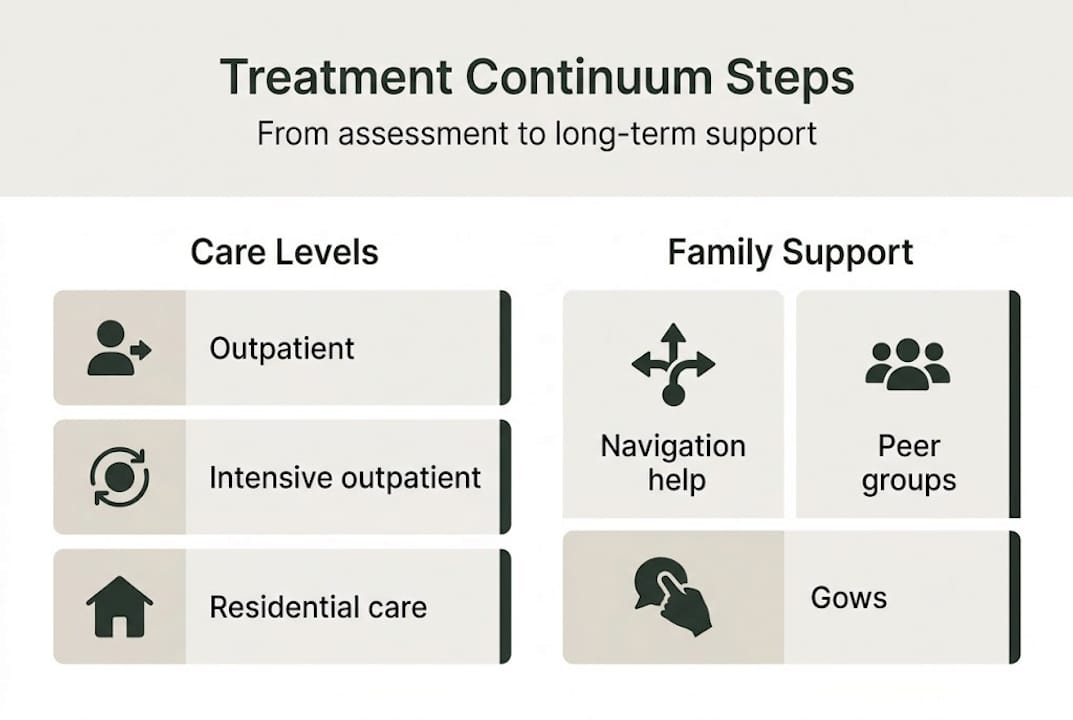
The American Society of Addiction Medicine (ASAM) developed the most widely recognized framework for this system. ASAM levels range from least to most intensive:
- Level 1.0: Standard outpatient services (fewer than 9 hours per week)
- Level 2.1: Intensive Outpatient Program (IOP), typically 9 or more hours per week
- Level 3.1 to 3.5: Residential treatment, ranging from clinically managed low-intensity to medically monitored high-intensity care
- Level 4-WM: Medically managed inpatient withdrawal (detox)
Los Angeles County formally uses ASAM tiered care levels as part of its Substance Abuse Prevention and Control (SAPC) provider standards. This means that local providers are expected to assess patients using standardized criteria and place them at the appropriate level, not simply the most convenient one.
Assessment is the critical first step. A trained clinician evaluates factors like withdrawal risk, mental health history, living environment, and prior treatment episodes. That evaluation determines where someone enters the continuum, and it is reviewed regularly to guide transitions up or down.
For those unfamiliar with where to begin, local addiction help in Los Angeles is available through several entry points, including CENS (Care and Navigation Services), which connects residents to appropriate providers across the county. If you are still working through understanding substance dependence itself, that foundation will help you make sense of why different levels of care exist.
Pro Tip: Do not assume that starting at the lowest level of care is always the right move. Assessment determines entry point. Someone with severe withdrawal risk or co-occurring mental health conditions may need to begin at a residential or inpatient level before stepping down.
“The goal of the continuum is not to move people through as quickly as possible. It is to match the right intensity of care to the right person at the right time.”
Main levels of care in an addiction treatment continuum
With that foundation in mind, let’s break down exactly what each level of care involves and how they interact throughout someone’s recovery journey.
| Level | Setting | Best suited for |
|---|---|---|
| Outpatient (1.0) | Clinic or community center | Mild to moderate substance use, stable home |
| Intensive Outpatient (2.1) | Outpatient facility | Moderate severity, needs structure but can live at home |
| Residential (3.1 to 3.5) | 24-hour facility | High severity, unstable environment, co-occurring disorders |
| Inpatient Withdrawal (4-WM) | Hospital or medical unit | Severe physical dependence, medical risk during detox |
LA County providers use SAPC and ASAM criteria to define and assign these levels, ensuring that care decisions are clinically grounded rather than based on availability or cost alone.
Here is how a typical patient might move through the continuum after an initial assessment:
- Complete a clinical assessment with a licensed counselor or physician
- Enter the appropriate level based on severity (for example, inpatient detox if medically necessary)
- Transition to residential care once medically stable
- Step down to an Intensive Outpatient Program as functioning improves
- Move to standard outpatient services for ongoing counseling and relapse prevention
- Engage in aftercare, peer support, and community-based recovery resources
For those weighing early-stage options, learning about choosing the best outpatient detox can clarify whether that level fits your situation. Families considering structured programming should also review the benefits of intensive outpatient programs to understand what that middle tier offers.

The CENS navigation resource in LA County is a practical tool for connecting to the right provider at the right level, particularly for individuals who are uninsured or unsure where to start.
Pro Tip: Teens and adults with high-risk profiles, such as a history of overdose, severe mental illness, or unstable housing, may start at a more intensive level and step down over time. This is not a setback. It is tailored care working exactly as it should.
Why a full continuum matters: Evidence and outcomes
Understanding what the continuum looks like is important, but does it really make a difference for you or your family? The evidence is clear.
One of the most striking findings in addiction medicine is that outpatient follow-up after detox reduces mortality by 53% compared to those who receive no follow-up care. That is not a minor improvement. It is the difference between life and death for a significant portion of patients.
| Outcome measure | Full continuum care | Fragmented care |
|---|---|---|
| Treatment dropout rate | Significantly lower | Higher |
| Post-detox mortality | Reduced by up to 53% | Baseline risk |
| Long-term sobriety (12 months) | Improved | Lower rates |
| Hospital readmission | Reduced | More frequent |
“Engagement in outpatient follow-up after detoxification is one of the strongest predictors of survival and sustained recovery in patients with substance use disorder.”
The data points to a clear pattern. People who move through connected levels of care, rather than stopping after detox or a single program, experience better outcomes across every major metric. Reviewing addiction recovery best practices reinforces this point with additional clinical context.
It is also worth noting that more care is not always better care. Complex cases require tailored intervention. High-utilizers of services who cycle through crisis care without a coordinated plan can face worse outcomes than those receiving lower-intensity but consistent support. The ASAM levels explainer breaks down how matching intensity to need is the actual goal.
For families looking beyond treatment itself, exploring recovery support resources in Los Angeles can help bridge the gap between formal treatment and everyday life in the community.
How to access the treatment continuum in Los Angeles
Once you understand the value of the continuum, the next challenge is navigating your local options, especially in a complex landscape like Los Angeles.
Here are the steps most individuals and families follow to initiate care:
- Contact a local provider or CENS for an intake screening
- Complete a full clinical assessment to determine the appropriate level of care
- Receive a placement recommendation and connect with the matched provider
- Begin treatment at the assigned level
- Participate in regular reviews to assess progress and adjust care intensity
- Transition to the next level (up or down) based on clinical need
Key resources available in Los Angeles County include:
- CENS (Care and Navigation Services): Connects individuals to the right level of care across LA County
- SAPC (Substance Abuse Prevention and Control): Oversees provider standards and funding
- Community-based outpatient clinics: Serve mild to moderate cases with flexible scheduling
- Residential treatment facilities: Provide structured, 24-hour care for higher-need individuals
- Telehealth and evening IOP programs: Serve working adults and teens with scheduling constraints
CENS navigation helps connect people to the right local services, particularly for those who are uninsured, experiencing homelessness, or unsure how to start. This free service reduces the guesswork that often delays treatment entry.
Teens have specific needs that require specialized pathways. Reviewing teen addiction recovery steps in Los Angeles can help families understand how the process differs for younger individuals, including school-based considerations and family involvement requirements.
Pro Tip: When evaluating providers, ask directly whether they support the full continuum or only one level of care. Not every facility can facilitate step-up or step-down transitions. Knowing this upfront prevents gaps in care that can lead to relapse.
When you are ready to take action, getting started with a local recovery center is a straightforward first step toward connecting with a team that can guide your placement.
Why the treatment continuum isn’t a straight line: Our take
Even with this clear structure, it is important to recognize that real recovery journeys rarely move forward in a perfect sequence. At Glendora Recovery Center, we see this every day.
Some people step down to outpatient care and then need to return to a higher level after a relapse. Others plateau in residential treatment and need a different therapeutic approach before they can progress. These are not failures. They are the normal, human reality of recovery from a chronic condition.
Research supports this view. Tailored interventions are crucial because high-utilizers of care who cycle through services without a coordinated, individualized plan can actually face worse outcomes. The continuum is a framework, not a rigid script.
What matters most is continuity and responsiveness. Families should not measure progress only by which step their loved one is on. They should look for consistent engagement, honest communication with providers, and a care plan that adapts. Understanding your substance abuse support workflow can help reframe what meaningful progress actually looks like.
Find support for your recovery journey
Having a roadmap is just the first step. Accessing the right support is what moves recovery forward. At Glendora Recovery Center, we offer care across multiple levels, including Partial Hospitalization Programs, Intensive Outpatient Programs, aftercare, and telehealth options, so you or your loved one can receive the right level of support at every stage. Explore our full treatment options in Los Angeles to see what fits your situation. If you want a broader picture of how our approach works, our guide to comprehensive addiction recovery is a helpful starting point. Ready to take the next step? Speak with a recovery advisor today.
Frequently asked questions
What does a treatment continuum include?
A treatment continuum consists of a connected set of care levels, including outpatient, intensive outpatient, residential, and inpatient withdrawal management, allowing people to step up or down as their needs change.
Why is it important to follow all steps of the continuum?
Staying engaged through all recommended levels reduces dropout and mortality, lowers relapse risk, and significantly increases the chances of lasting recovery.
How do I access the right level along the continuum in Los Angeles?
LA County uses CENS navigation and SAPC assessment tools to connect people to the best-fitting level of care. Families and individuals can start with a local provider or contact CENS directly.
Can teens start at a different level than adults?
Yes. Teens or adults with high-risk needs may begin with residential or intensive services and step up or down as their care plans evolve based on clinical reassessment.
Recommended
- Comprehensive Addiction Treatment: Lasting Recovery Explained | Glendora Recovery Center
- Comprehensive Mental Health Treatment: Pathways to Recovery | Glendora Recovery Center
- Family Therapy Workflow Addiction: Effective Steps for Recovery | Glendora Recovery Center
- Role of Family in Recovery – Supporting Lasting Change | Glendora Recovery Center
- Complete Guide to the Role of Family Counselling – Interactive Counselling