
TL;DR:
- Most adults with substance use disorder started using before age 18.
- Teen brains are more vulnerable to addiction due to ongoing development and heightened reward response.
- Early intervention significantly reduces long-term addiction risk and improves recovery outcomes.
Over 90% of adults with substance use disorder began using substances before age 18. That statistic should stop every parent in their tracks. When teens experiment with drugs or alcohol, the stakes are far higher than most families realize. The teenage brain is wired differently from an adult brain, and that difference makes adolescents far more vulnerable to addiction. This article walks you through the science, the data, and the practical steps you need to protect your teen’s future before a problem becomes a crisis.
Table of Contents
- How adolescent brain development increases addiction risk
- Why early intervention is critical: Data and outcomes
- The importance of addressing co-occurring mental health issues
- Why general approaches fail: The need for youth-specific programs
- A better way forward: Specialized treatment isn’t a luxury, it’s a necessity
- Specialized treatment options for your teen in Los Angeles
- Frequently asked questions
Key Takeaways
| Point | Details |
|---|---|
| Teens’ brains are more vulnerable | Brain development makes teens form addictions faster and require special care. |
| Early action prevents lifelong problems | Intervening early can stop teen substance use from becoming adult addiction. |
| Integrated care is essential | Treating mental health and addiction together is proven to deliver better recovery odds. |
| Generic programs aren’t enough | Teens need youth-focused, engaging approaches for successful recovery. |
| Specialized help is available locally | Los Angeles has effective programs for teens; reaching out changes outcomes. |
How adolescent brain development increases addiction risk
Understanding why teens are so vulnerable to addiction starts with one key structure: the prefrontal cortex. This is the part of the brain responsible for decision-making, impulse control, and weighing consequences. In adults, it operates at full capacity. In teenagers, it is still under construction. The prefrontal cortex is not fully developed until around age 25, which means teens are literally making decisions with an incomplete brain.
This is not about willpower or character. It is biology. When a teen encounters a substance, the brain’s reward system floods with dopamine, producing an intense sense of pleasure. Without a fully functioning prefrontal cortex to apply the brakes, the pull toward repeating that experience is much stronger than it would be for an adult.
Brain plasticity, the brain’s ability to reorganize and form new connections, is at its peak during adolescence. This is wonderful for learning and skill development. But it also means habits, including harmful ones, form faster and stick harder. A teen who uses substances regularly is literally reshaping their developing brain around that behavior.
Here is how the teen brain compares to the adult brain when it comes to substance use:
| Factor | Teen brain | Adult brain |
|---|---|---|
| Prefrontal cortex | Still developing | Fully developed |
| Dopamine response | Heightened | More regulated |
| Habit formation | Rapid | Slower |
| Impulse control | Limited | Stronger |
| Speed of addiction | Faster | Slower |
Because of these differences, teens progress to addiction more quickly than adults. Teens’ developing prefrontal cortex makes them significantly more susceptible to addiction than their adult counterparts. This is why parents should never assume their teen will simply “grow out of it.”
Key biological risk factors in adolescent substance use include:
- Incomplete impulse control leading to repeated use
- Heightened dopamine sensitivity making substances feel more rewarding
- Rapid habit formation due to peak brain plasticity
- Emotional regulation challenges common in adolescence
- Greater sensitivity to peer influence during social brain development
If you want to understand more about these teen addiction facts, the science makes a compelling case for early action. The biology is not a life sentence, but it does mean parents cannot afford to wait.
Why early intervention is critical: Data and outcomes
The data on early substance use and long-term outcomes is striking. Teens who begin using substances before age 15 are 6.5 times more likely to develop a substance use disorder later in life compared to those who wait until adulthood. Every year of delayed first use reduces that risk significantly.
Think about what that number means in practical terms. A 13-year-old who starts using cannabis or alcohol is not just making a teenage mistake. They are setting a neurological and behavioral pattern that dramatically increases their chances of struggling with addiction as an adult.
Here is a look at how the age of first use affects long-term addiction risk:
| Age of first use | Lifetime SUD risk |
|---|---|
| Before age 13 | Highest risk |
| Ages 13 to 15 | Very high risk |
| Ages 16 to 17 | Elevated risk |
| Age 18 or older | Significantly lower risk |
Understanding why treat teen addiction early is not just about stopping current use. It is about protecting the adult your teen is becoming. Early intervention can interrupt the neurological patterns being laid down right now.
If you suspect your teen is using substances, here are the steps to take:
- Stay calm and approach your teen with curiosity, not accusation
- Document specific behavioral changes you have observed
- Consult your teen’s pediatrician or a licensed counselor
- Contact a specialized adolescent treatment program for a professional assessment
- Involve the family in the process to create a consistent support system
Parents sometimes wait for things to get worse before seeking help, hoping the problem will resolve on its own. That delay is costly. Understanding what teens learn in treatment can also ease parental fears about the process itself.
Pro Tip: Act at the earliest signs of concern. Denial and hesitation waste the most valuable window for intervention. A professional assessment costs far less than years of untreated addiction.
The importance of addressing co-occurring mental health issues
Substance use in teens rarely exists in isolation. Many adolescents who struggle with drugs or alcohol are also dealing with anxiety, depression, ADHD, trauma, or other mental health challenges. These are called co-occurring disorders, and they are extremely common in the teen population.

When a teen uses substances to manage anxiety or numb emotional pain, treating only the substance use misses the root cause. The mental health issue remains, and without healthy coping tools, the risk of relapse stays high. This is why integrated treatment, addressing both substance use and mental health at the same time with the same clinical team, produces better outcomes.
Integrated care models consistently improve outcomes for individuals with co-occurring disorders compared to treating each condition separately. For teens, this is especially important because mental health and substance use are often deeply intertwined in their daily experience.
Signs that your teen may have co-occurring mental health needs include:
- Persistent low mood or hopelessness lasting more than two weeks
- Intense anxiety or panic that interferes with school or social life
- Significant difficulty focusing or controlling impulses beyond typical teen behavior
- History of trauma, bullying, or significant loss
- Using substances specifically to “feel normal” or manage stress
Choosing a program that understands managing dual diagnosis means your teen gets care that treats the whole person, not just the substance use.
Pro Tip: When evaluating treatment programs, ask specifically about their experience with co-occurring disorders. A program that treats addiction without mental health support is working with half the picture.
Why general approaches fail: The need for youth-specific programs
Many addiction treatment programs were designed with adults in mind. The therapy models, group dynamics, language, and even the physical environment often reflect adult experiences and adult concerns. Placing a teenager in that setting is a poor fit, and the outcomes reflect it. Our team frequently points clients toward choosing the right treatment program for added context.
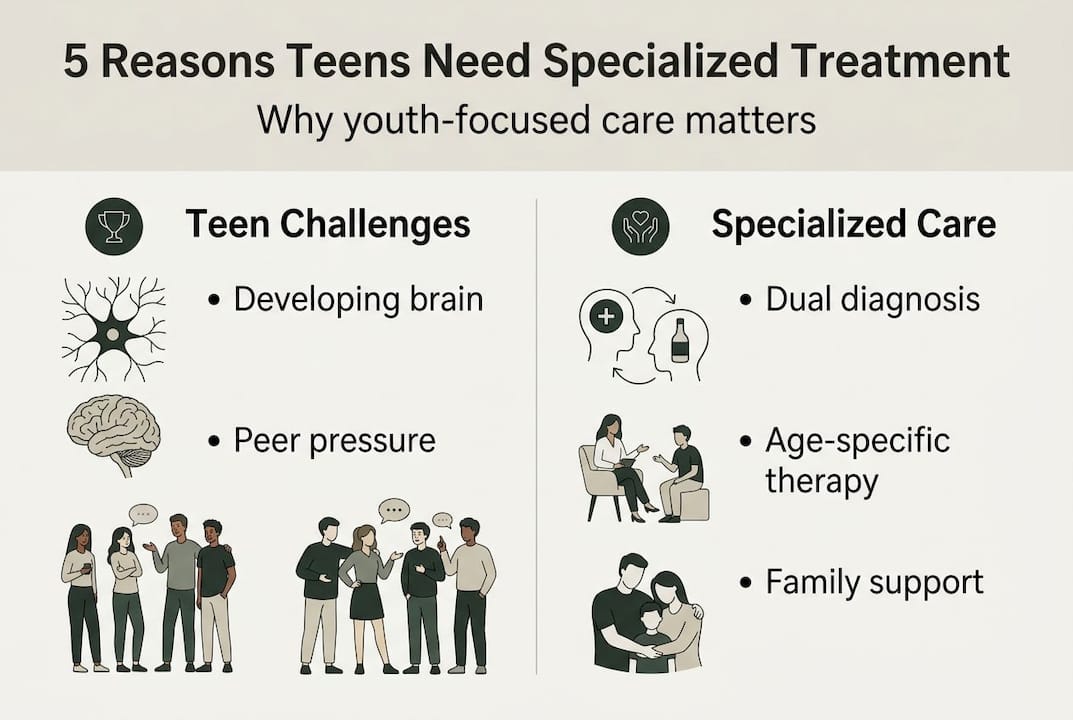
Teens disengage quickly when treatment does not feel relevant to their lives. They need peers their own age, therapists who understand adolescent development, and activities that connect recovery to their real world of school, family, and friendships. When those elements are missing, teens drop out. Understanding the addiction treatment continuum can make the road ahead feel more manageable.
Only 36.8% of adolescents with cannabis use disorder complete treatment, which highlights just how critical youth-specific programming is for keeping teens engaged and improving outcomes. That means nearly two out of three teens do not finish treatment when programs fail to meet their needs.
Effective teen treatment programs share several core elements:
- Age-appropriate peer group therapy with other adolescents
- Academic support to prevent falling behind in school
- Family involvement and family therapy components
- Evidence-based therapies adapted for adolescent development
- Life skills training relevant to teen social situations
- Trauma-informed care that recognizes common adolescent experiences
The teen drug abuse treatment benefits of a youth-specific program go well beyond just completing the program. Teens who receive age-appropriate care build stronger coping skills, better family relationships, and a clearer sense of identity in recovery.
There are also many teen treatment myths that discourage parents from seeking help, such as the belief that treatment is too disruptive to school life or that teens are too young for formal programs. These concerns are understandable, but they should not delay action.
Pro Tip: When researching programs, ask whether they specialize in adolescent substance use. A center that primarily treats adults may not have the staff training, peer environment, or therapeutic tools your teen needs. Personalized addiction treatment tailored to your teen’s age and circumstances makes a measurable difference.
A better way forward: Specialized treatment isn’t a luxury, it’s a necessity
Here is something parents deserve to hear plainly: placing a teenager in a generic adult treatment program is not a neutral choice. It is a choice that reduces the odds of success. The evidence is clear. Teen brains are different, teen social worlds are different, and teen recovery needs are different.
At Glendora Recovery Center, we have seen what happens when families choose specialized, integrated care early. Teens do not just stop using substances. They develop emotional tools, rebuild family trust, and re-engage with their futures. That is not a short-term fix. That is the foundation of a healthy adult life.
The lifelong impact of adolescent addiction treatment is not just about avoiding addiction. It is about giving your teen the skills and self-awareness to navigate life’s pressures without turning to substances. Specialized care is not a luxury reserved for severe cases. It is the standard every teen deserves.
Specialized treatment options for your teen in Los Angeles
If you are a parent in Los Angeles concerned about your teen’s substance use, you do not have to figure this out alone. Glendora Recovery Center offers specialized adolescent addiction treatment that addresses both substance use and co-occurring mental health conditions. Our programs include Partial Hospitalization Programs, Intensive Outpatient Programs, and flexible scheduling options designed to fit around school and family life.
Our clinical team specializes in dual diagnosis recovery and adolescent care, using evidence-based therapies in an environment built for teens. Explore our full range of Los Angeles addiction treatment options and take the first step toward protecting your teen’s future today.
Frequently asked questions
What’s the difference between teen and adult addiction treatment?
Teen treatment uses age-specific therapies, peer groups, and addresses co-occurring issues like anxiety or depression, while adult programs often miss these unique developmental needs. Teens’ developing brains and social environments require a fundamentally different clinical approach.
Why do teens relapse more often than adults?
Teens relapse more due to ongoing brain development, peer pressure, and lower engagement when placed in programs that do not fit their needs. Only 36.8% of teens with cannabis use disorder complete treatment, showing how critical program fit really is.
How can parents spot early signs that their teen needs help?
Watch for significant changes in mood, friend groups, sleep patterns, or academic performance, as these are often the first visible signals that something is wrong. Early action is always more effective than waiting for the situation to worsen.
Do specialized teen treatment programs include mental health care?
Yes, the most effective programs treat both mental health and substance use at the same time with an integrated clinical team. Integrated care consistently improves outcomes for teens with co-occurring disorders.
Is specialized treatment available in Los Angeles for teens?
Yes, Los Angeles and the surrounding areas, including Glendora, offer several centers that specialize in adolescent addiction and mental health care. Glendora Recovery Center serves families throughout Los Angeles County with youth-focused programs.
Recommended
- Benefits Of Teen Group Therapy You Need To Know
- Our IOP For Teens Programs Able To Bring The Best Results
- Why treat teen addiction: key reasons and recovery benefits | Glendora Recovery Center
- How We Pick The Best Teen Treatment For Your Teenager?
- A Compassionate Guide to Children and Hospice Care | Graceland Hospice Care Blog