
TL;DR:
- A personalized treatment plan outlines diagnosis, goals, interventions, and progress monitoring for recovery. Regular reviews and active involvement are key to its effectiveness. Addressing dual diagnosis and life changes improves treatment outcomes.
Many people entering addiction or mental health treatment assume a treatment plan is just a form their provider fills out on day one and files away. That assumption can cost real progress. A treatment plan is a detailed, personalized document outlining your diagnosis, goals, interventions, and how your progress will be tracked over time. It is the backbone of any serious recovery effort, and understanding what goes into one can help you make smarter decisions about your care, ask better questions, and hold your treatment team accountable. For anyone navigating addiction or mental health challenges in Los Angeles County, knowing how a strong plan is built can genuinely change outcomes.
Table of Contents
- What exactly is a treatment plan?
- Core elements and structure of effective treatment plans
- Personalization: Why one-size-fits-all doesn’t work
- Building and adapting your treatment plan: A practical guide
- The overlooked truth about treatment planning
- Take the next step: Find support with your treatment plan
- Frequently asked questions
Key Takeaways
| Point | Details |
|---|---|
| Personalized approach | Effective treatment plans are tailored to your unique diagnosis, goals, and circumstances. |
| Evidence-based methods | Successful plans use science-backed therapies, regular review, and measurable progress tracking. |
| Flexibility is key | Adjusting your plan to new challenges or setbacks reduces the risk of relapse. |
| Integrated support | Combining medication, therapy, and social support improves recovery outcomes. |
| Self-advocacy matters | Your input and ongoing communication shape the most effective plan for your recovery. |
What exactly is a treatment plan?
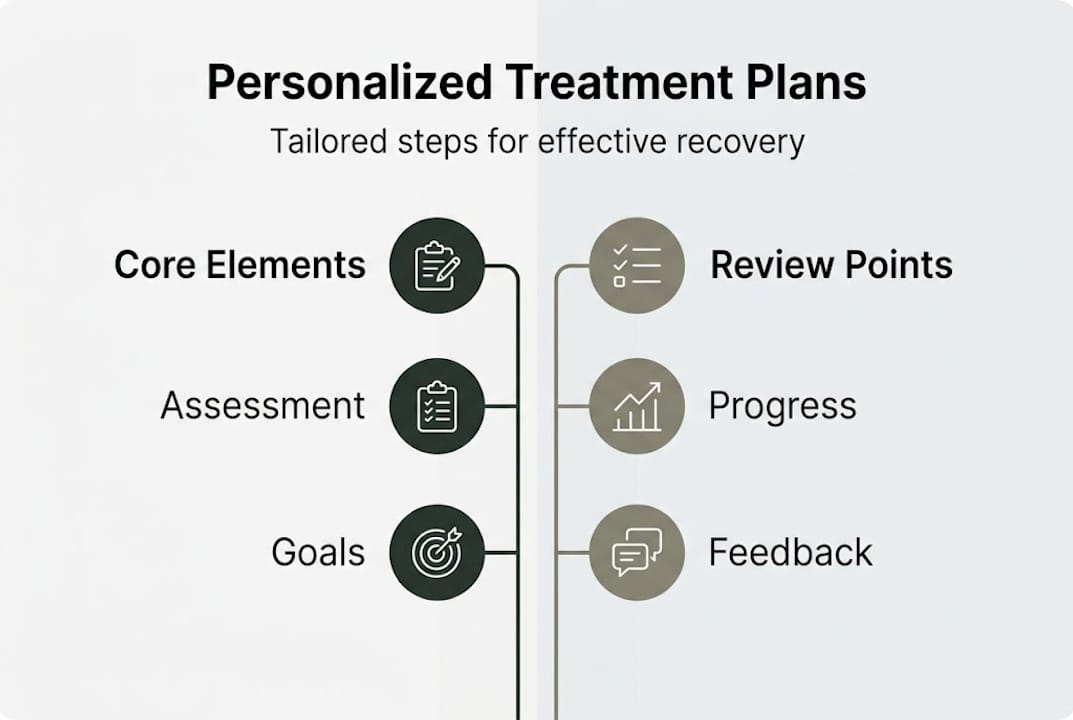
A treatment plan is far more than a checklist. Think of it as a personalized roadmap that connects where you are right now to where you want to be in recovery. It captures your clinical picture, sets measurable goals, identifies the specific therapies and supports you will use, and creates a system for checking whether things are working.
According to clinical guidance on treatment planning for substance use, an effective plan documents your diagnosis, treatment goals, chosen interventions, and a clear method for monitoring progress. That structure applies whether you are dealing with alcohol use disorder, opioid dependence, depression, anxiety, or a combination of these.
Here is a quick look at the standard components:
| Component | What it covers |
|---|---|
| Assessment and diagnosis | Clinical evaluation of substance use, mental health, medical history |
| Goals and objectives | Short and long-term recovery targets, written in measurable terms |
| Interventions | Specific therapies, medications, or programs selected for your needs |
| Progress monitoring | Tools and timelines for evaluating whether goals are being met |
| Plan revision | Scheduled reviews to adjust the plan as your needs change |
A good treatment plan should answer these core questions:
- What is the primary diagnosis or concern driving this treatment?
- What does the patient want to achieve, and by when?
- Which evidence-based interventions are being used and why?
- How will progress be measured and how often?
- Who is responsible for each part of the plan?
Plans for addiction treatment often emphasize medical stabilization, withdrawal management, and behavioral therapy. Mental health plans may focus more heavily on psychotherapy and medication management. When both conditions exist together, the plan must address them in an integrated way, which is where personalized treatment benefits become especially clear. Understanding the recovery plan basics before you enter treatment gives you a real advantage.
Pro Tip: Be as honest as possible during your initial assessment. Providers can only build a plan around what they know. Downplaying symptoms or substance use history often leads to a plan that misses the mark entirely.
Core elements and structure of effective treatment plans
Knowing what a treatment plan contains is one thing. Understanding what makes it actually work is another. Research and clinical guidelines point to five core building blocks that separate effective plans from ineffective ones.
- Thorough assessment – Before any goals are set, a complete picture of your physical health, substance use history, mental health status, and social environment must be established.
- Collaborative goal-setting – Goals should be specific, realistic, and co-created with you. Vague targets like “stop using” rarely translate into lasting change.
- Evidence-based interventions – The therapies and medications selected should have research backing them. Cognitive behavioral therapy (CBT), motivational interviewing, and medication-assisted treatment (MAT) are common examples.
- Regular monitoring – Progress should be tracked using validated tools, not just clinical intuition. Standardized measures create accountability for both the patient and the provider.
- Scheduled plan adaptation – Life changes. A plan that made sense in month one may need significant revision by month three.
The evidence behind these steps is compelling. Research on evidence-based addiction treatment shows that combining CBT with pharmacotherapy outperforms either approach alone, that medications for opioid use disorder (MOUD) such as methadone increase treatment retention by 4x, and that psychotherapy produces response rates of 60 to 70 percent when properly applied.
“Meaningful changes in recovery require a minimum of 90 service days. Plans that cut treatment short before this threshold are statistically less likely to produce lasting results.”
This 90-day benchmark is supported by SAMHSA recommendations and the American Society of Addiction Medicine (ASAM) criteria, both of which guide how licensed programs structure care. Following a clear recovery steps checklist and understanding the outpatient treatment process can help you stay oriented throughout your care.
Regular plan reviews are not optional extras. They are what prevent small setbacks from becoming full relapses. When providers and patients check in consistently, early warning signs get caught before they escalate.

Personalization: Why one-size-fits-all doesn’t work
One of the most common failures in addiction and mental health treatment is applying a generic template to a highly individual problem. A plan designed for a 25-year-old with mild alcohol use disorder will not serve a 45-year-old managing opioid dependence alongside post-traumatic stress disorder.
Dual diagnosis, meaning the presence of both a substance use disorder and a mental health condition, is one of the most important factors requiring personalization. When dual diagnosis is missed or treated separately, outcomes suffer significantly. As clinical guidelines confirm, integrated care that addresses both conditions simultaneously is essential, not optional.
Here is how personalized and generic plans compare:
| Factor | One-size-fits-all plan | Personalized plan |
|---|---|---|
| Engagement | Lower, feels irrelevant | Higher, feels relevant and achievable |
| Outcomes | Inconsistent | Consistently better across studies |
| Relapse risk | Higher | Lower with regular adaptation |
| Dual diagnosis | Often overlooked | Fully integrated into care |
Other situations that demand individualized planning include severe withdrawal requiring medical stabilization before therapy can begin, low motivation levels that call for motivational interviewing before goal-setting, and varying cultural or social contexts that affect what support systems are available.
Watch for these red flags that suggest a plan is too generic:
- Goals are identical for every patient in the program
- No mention of mental health screening or co-occurring conditions
- Therapy modalities are not explained or justified
- No timeline for plan review is established
- Family or social factors are completely absent
Understanding what dual diagnosis centers provide and learning about managing dual diagnosis can help you identify whether a program is equipped to handle your full clinical picture.
Pro Tip: You have the right to ask your treatment team why specific therapies were chosen for you. If they cannot explain the reasoning in plain language, that is worth pushing back on. For a closer look, see how why recovery isn’t linear supports long-term recovery.
Building and adapting your treatment plan: A practical guide
A treatment plan is not something that happens to you. You are an active participant in building it, and that involvement directly affects how useful it becomes. Effective plans integrate biological, psychological, and social factors together, which means medications or detox, therapy, and family or community support all have a role. Understanding why professional treatment matters can make the road ahead feel more manageable.
Here is how each party contributes:
- You (the patient): Share your history honestly, state your goals clearly, and speak up when something is not working.
- Your clinical team: Conduct thorough assessments, recommend evidence-based interventions, and schedule regular reviews.
- Family members: Provide context, participate in family therapy when appropriate, and support accountability at home.
When looking for a licensed program in Los Angeles County, use the SAMHSA treatment locator to filter by accreditation, services offered, and location. Look for programs that follow ASAM criteria, as this signals a structured, clinically grounded approach.
Questions to ask before committing to a program:
- Will my plan be individualized based on a full assessment?
- How often will my plan be reviewed and updated?
- What tools do you use to track my mental health progress?
- How is family involvement handled?
- What happens if my needs change during treatment?
For mental health tracking specifically, validated tools like the PHQ-9 for depression and the GAD-7 for anxiety provide objective data that helps your team adjust your plan with precision rather than guesswork. Understanding family involvement in rehab is also worth exploring before you begin.
Pro Tip: If your living situation, employment, or relationships change significantly during treatment, tell your provider right away. These shifts affect your risk level and your plan should reflect them.
The overlooked truth about treatment planning
Most conversations about treatment plans focus on what goes into the initial document. Far fewer address what happens after that first session. At Glendora Recovery Center, we have seen firsthand that the quality of a plan at intake matters far less than how actively it is revised throughout the recovery process.
Los Angeles County presents a uniquely complex clinical environment. Cultural diversity, economic variation, and the sheer range of substances and co-occurring conditions seen here mean that a plan built in week one will almost certainly need meaningful updates by week six. Rigid plans that treat the initial assessment as a finished product consistently underserve patients.
The real measure of a strong program is not the plan itself but the feedback loop built around it. Patients should expect, and demand, regular check-ins where their voice shapes what comes next. Recovery is not linear, and your plan should not pretend otherwise. Exploring the adaptive recovery workflows we use can show you what that ongoing responsiveness looks like in practice.
Take the next step: Find support with your treatment plan
Understanding what a treatment plan should contain is a powerful first move. Acting on that knowledge is what changes lives. At Glendora Recovery Center, every patient receives a thorough, individualized assessment and a plan that evolves with their recovery. Our team specializes in addiction treatment in Los Angeles, including dual diagnosis care, Partial Hospitalization Programs, and Intensive Outpatient Programs with flexible scheduling. We believe your plan should reflect your life, not a generic template. To learn more about our comprehensive treatment options or to speak with someone about your specific situation, contact our team today. You do not have to figure this out alone.
Frequently asked questions
What is included in a mental health or addiction treatment plan?
A typical plan includes your assessment, diagnosis, treatment goals, recommended therapies or medications, and progress tracking steps. As clinical guidance confirms, these elements work together to create a structured path toward recovery.
How do I know if my treatment plan is high quality?
A high-quality plan is personalized, regularly updated, involves your input, uses evidence-based methods, and tracks concrete goals. SAMHSA stresses FDA-approved medications, behavioral therapies, and consistent progress tracking as markers of quality care.
Why do some people relapse even with a treatment plan?
Relapse can happen when a plan is too rigid, not updated for life changes, or misses underlying issues like dual diagnosis. Inflexible plans risk disengagement and increase the likelihood of returning to substance use.
Where can I find a licensed treatment provider in Los Angeles County?
Use the SAMHSA treatment locator to find local, accredited programs that match your specific needs and preferences.
What is a dual diagnosis and how does it affect my treatment plan?
A dual diagnosis means you have co-occurring mental health and substance use issues, so your plan must address both conditions together. Integrated care plans are essential for this population to avoid treating only half the problem.
Recommended
- Recovery Plan: Everything You Need to Know | Glendora Recovery Center
- 7 Steps to a Successful Addiction Recovery Checklist | Glendora Recovery Center
- Step-by-Step Process for Outpatient Addiction Treatment | Glendora Recovery Center
- Creating a Home Environment for Recovery: Step-by-Step Guide | Glendora Recovery Center
- Graceland Hospice Care | Compassionate End-of-Life Care