
TL;DR:
- Psychiatrists in Los Angeles conduct comprehensive assessments to identify co-occurring mental health conditions.
- Medication management by psychiatrists helps stabilize brain chemistry, reduce cravings, and treat mental illnesses.
- Integrated psychiatric care and programs like ECM and AOT-LA are vital for lasting addiction recovery.
Most people picture addiction treatment as a detox stay followed by weekly counseling sessions. That picture is incomplete. In Los Angeles County, psychiatrists quietly power some of the most effective recovery outcomes by doing work that goes far beyond simply prescribing medication. They diagnose hidden conditions, coordinate complex care teams, and guide patients through the medical realities of long-term recovery. If you or someone you love is navigating substance use disorder in LA, understanding what psychiatrists actually do can change the kind of help you seek and dramatically improve the chances of lasting recovery.
Table of Contents
- Understanding psychiatric assessment in addiction care
- Medication management and integrative treatment
- Psychiatrists in dual diagnosis and co-occurring disorders
- Local programs: Psychiatrists and integrated care in Los Angeles
- The overlooked impact: Why psychiatrists are vital for recovery in LA
- Find comprehensive addiction care in Los Angeles
- Frequently asked questions
Key Takeaways
| Point | Details |
|---|---|
| Complete assessment is crucial | Psychiatrists provide vital evaluations for both addiction and mental health to create personalized care plans. |
| Medication plus therapy is best | Evidence shows combining psychiatric medication with psychosocial interventions gives the best outcomes. |
| Dual diagnosis needs expert care | Psychiatrists are essential for managing cases where addiction co-exists with another mental health disorder. |
| Local programs make a difference | LA County’s ECM and AOT-LA programs show integrated psychiatric care can improve access and recovery support. |
Understanding psychiatric assessment in addiction care
Every effective recovery plan starts with an accurate picture of what is really happening. Addiction rarely travels alone. Anxiety, depression, trauma, and personality disorders frequently occur alongside substance use disorder, and missing any one of them can cause a treatment plan to collapse. Psychiatrists are trained to see this full picture.
A psychiatric assessment in addiction care is not a brief intake form. It typically involves a structured clinical interview, review of medical and family history, and cognitive testing to evaluate memory, judgment, and executive function. Psychiatrists also screen for medical conditions that mimic or worsen psychiatric symptoms, such as thyroid disorders or traumatic brain injuries.
In Los Angeles County, these assessments are guided by the ASAM Criteria, a nationally recognized framework that evaluates six dimensions of a patient’s life, including withdrawal potential, medical conditions, emotional readiness, and living environment. This multi-dimensional approach ensures that placement and treatment intensity match a person’s actual needs rather than a generalized protocol.
Psychiatrists conduct comprehensive assessments to diagnose addiction and co-occurring mental health disorders, enabling tailored treatment plans. This foundational step prevents what so many people experience: entering a program that treats only the surface while leaving deeper conditions untouched.
Key areas psychiatrists assess during an addiction evaluation include:
- Substance use history: Types, frequency, and duration of use
- Withdrawal risk: Physical and psychological severity of stopping
- Co-occurring diagnoses: Mental health conditions present before or alongside addiction
- Cognitive functioning: Ability to participate in and retain treatment
- Trauma history: Past events that may drive substance use behavior
- Social and environmental factors: Housing stability, support networks, legal issues
| Assessment tool | What it measures | Why it matters |
|---|---|---|
| Psychiatric interview | Mood, psychosis, trauma | Identifies co-occurring diagnoses |
| Cognitive testing | Memory and judgment | Guides treatment complexity |
| ASAM Criteria evaluation | All six life dimensions | Determines level of care |
| Medical history review | Physical health contributors | Rules out organic causes |
Pro Tip: Bring a full list of all current medications and any known family mental health history to your first psychiatric appointment. This information directly shapes your diagnosis and treatment plan.
For those navigating both addiction and a separate mental health condition, managing dual diagnosis is a structured process that psychiatrists help lead from the very beginning.
Medication management and integrative treatment
Once a comprehensive assessment is complete, psychiatrists turn to one of their most impactful tools: medication. This is not about replacing one substance with another. It is about using evidence-based medicine to stabilize brain chemistry, reduce dangerous withdrawal symptoms, lower cravings, and treat conditions like depression or anxiety that might otherwise push a person back toward substance use.

Medication management by psychiatrists includes prescribing drugs to manage withdrawal, reduce cravings, and treat co-occurring conditions like depression or anxiety. The specific medications chosen depend on the substance involved, the patient’s medical profile, and what other treatments are being used alongside medication.
Common medications used in addiction care include:
- Naltrexone: Blocks opioid and alcohol reward signals in the brain, reducing cravings
- Buprenorphine: Treats opioid dependence by partially activating opioid receptors with lower abuse potential
- Acamprosate: Reduces alcohol withdrawal discomfort and supports sustained abstinence
- Disulfiram: Creates an unpleasant reaction to alcohol, acting as a deterrent
- Antidepressants or mood stabilizers: Address co-occurring depression, anxiety, or bipolar disorder
VA/DoD guidelines recommend pharmacotherapy such as naltrexone for alcohol use disorder and buprenorphine for opioid use disorder, combined with psychosocial interventions led or coordinated by psychiatrists, as the most effective approach for sustained recovery.
Medication alone is rarely the complete answer. Psychiatrists in Los Angeles typically coordinate with therapists to combine pharmacotherapy with CBT for addiction, which helps patients identify the thought patterns and behaviors that sustain addiction.
| Approach | Focus | Who leads it |
|---|---|---|
| Pharmacotherapy only | Symptom and craving control | Psychiatrist |
| Psychotherapy only | Behavioral and emotional change | Therapist |
| Integrated treatment | Whole-person recovery | Psychiatrist and therapy team |
Integrated treatment is also more responsive. Psychiatrists regularly monitor medication effectiveness and adjust doses based on how the patient is progressing, which means the care plan stays aligned with where someone actually is in their recovery rather than where they started.
Psychiatrists in dual diagnosis and co-occurring disorders
Not all recovery journeys are straightforward. Many individuals in Los Angeles County face what clinicians call dual diagnosis, a term meaning the simultaneous presence of a substance use disorder and at least one mental health condition such as PTSD, bipolar disorder, schizophrenia, or major depression. These cases require a level of clinical coordination that goes well beyond standard addiction care.
Psychiatrists are the linchpin of dual diagnosis treatment. They assess which condition emerged first, how each condition affects the other, and which interventions should be prioritized at each stage of treatment. This sequencing matters enormously. Treating depression without addressing the alcohol use that drives it, for example, often produces poor outcomes for both.
The ASAM Criteria 4th Edition designates Dimension 3 specifically for psychiatric and cognitive conditions, requiring psychiatrists to assess active symptoms, persistent disabilities, and the need for integrated psychiatric management in co-occurring enhanced (COE) programs. This framework guides how care teams in Los Angeles County are structured and staffed.
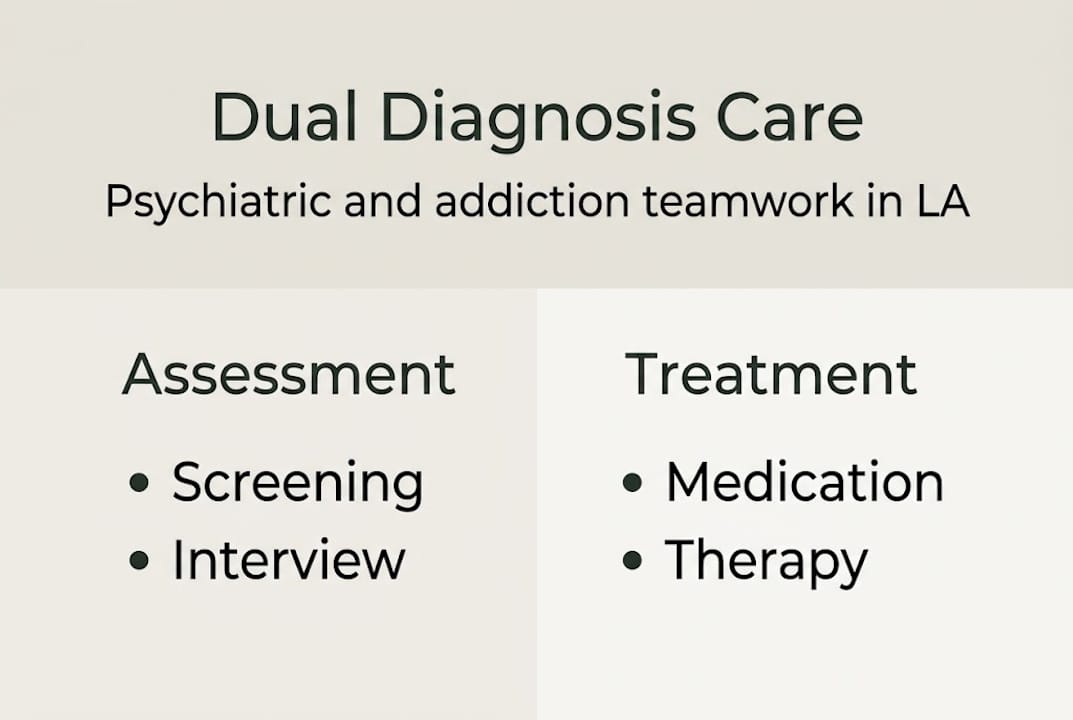
One critical but often overlooked element of dual diagnosis care is capacity assessment, the clinical process of determining whether a patient can meaningfully understand and consent to their own treatment. This matters especially when psychiatric symptoms are severe. Research shows that capacity assessment occurs in only 34.9% of dual diagnosis cases, which creates real gaps in consent and care quality, particularly in emergency settings.
Key responsibilities psychiatrists carry in dual diagnosis care include:
- Diagnosing and differentiating between primary and substance-induced psychiatric symptoms
- Leading or collaborating on integrated treatment planning
- Coordinating with therapists, case managers, and peer support specialists
- Reassessing psychiatric stability as recovery progresses
- Identifying when higher levels of care are needed
For people managing PTSD and trauma alongside addiction, psychiatric oversight ensures that trauma-informed care is embedded throughout the recovery process, not treated as a separate concern.
Pro Tip: Ask your treatment team directly whether your care plan includes regular reassessment for co-occurring conditions. As recovery progresses, psychiatric needs can shift, and your plan should reflect that.
For a closer look at how this process is structured, the dual diagnosis workflow describes how care teams coordinate across multiple specialties to support lasting recovery. You can also explore the dual diagnosis benefits of treating both conditions simultaneously rather than in isolation.
Local programs: Psychiatrists and integrated care in Los Angeles
Los Angeles County operates some of the most sophisticated psychiatric addiction care programs in the country. Two of the most impactful are Enhanced Care Management (ECM) and Assisted Outpatient Treatment Los Angeles (AOT-LA), and psychiatrists are central to both. We explore this further in our guide to how addiction affects families.
LA County psychiatrists integrate into Department of Mental Health programs including ECM for high-risk individuals with substance use disorder and serious mental illness, as well as AOT-LA for court-ordered outpatient treatment.
ECM is designed for Medi-Cal beneficiaries who have complex needs that a standard outpatient appointment cannot fully address. Psychiatrists within ECM teams provide direct clinical oversight while working alongside care coordinators, community health workers, and housing navigators. Eligibility generally includes individuals with serious mental illness, chronic substance use, and frequent emergency department or hospital visits. Our team frequently points clients toward how trauma drives addiction for added context.
ECM’s defining feature is its 24/7 outreach and care coordination capacity, which allows psychiatrists and support staff to engage patients where they are, whether that means a shelter, a street location, or after a hospital discharge.
AOT-LA is the county’s court-ordered outpatient treatment program for individuals who meet specific legal and clinical criteria. Psychiatrists conduct mandatory evaluations, develop and monitor treatment plans, and report back to the court on a patient’s progress. This accountability structure, while sometimes perceived negatively, often creates consistent engagement for individuals who have not responded to voluntary services.
| Feature | ECM | AOT-LA |
|---|---|---|
| Who qualifies | High-risk Medi-Cal beneficiaries | Court-ordered individuals |
| Psychiatric role | Care coordination and clinical oversight | Evaluation, treatment planning, court reporting |
| Access point | Referral through Medi-Cal or DMH | Court petition or county referral |
| Key strength | 24/7 community outreach | Structured accountability |
For anyone navigating substance dependence in Los Angeles, knowing that these programs exist and how to access them is an important step. Your primary care provider, a social worker, or a treatment facility like Glendora Recovery Center can connect you with referrals to either program.
The overlooked impact: Why psychiatrists are vital for recovery in LA
Here is something that rarely gets said plainly: most people who struggle to find lasting recovery in Los Angeles are not failing because they lack willpower or desire. They are failing because they are accessing only part of the care system. Psychiatric involvement is often the missing piece.
The reality in urban settings like Los Angeles is that stigma and access barriers prevent many people from ever reaching a psychiatrist. Some programs still operate with a separation between mental health and addiction services, leaving patients to navigate two systems that rarely communicate. That fragmentation is expensive, inefficient, and harmful.
Traditional one-size-fits-all treatment models consistently underperform for people with dual diagnoses. When someone’s depression is untreated, their cravings are harder to manage. When trauma goes unaddressed, relapse risk stays elevated regardless of how many meetings they attend. Psychiatrists bring the clinical authority and diagnostic precision to ensure these factors are not overlooked.
LA County is genuinely leading with integrated models through programs like ECM and AOT-LA. But the most important factor in any recovery is engagement. The person who connects with an integrated recovery center that offers psychiatric, medical, and psychosocial support together has a significantly stronger foundation than one who relies on a single intervention type.
Pro Tip: When evaluating any treatment program, ask specifically whether a psychiatrist is part of the care team and whether medication management is available alongside therapy. That combination is what the evidence consistently supports.
Find comprehensive addiction care in Los Angeles
At Glendora Recovery Center, psychiatric care is not an afterthought. It is built into how we treat addiction from day one. Whether you are managing a substance use disorder, a dual diagnosis, or both, our team provides access to psychiatry-led assessment, medication management, and evidence-based therapy under one roof. Our addiction treatment options include Partial Hospitalization Programs, Intensive Outpatient Programs, and telehealth sessions with flexible scheduling designed for real life. We also offer specialized support through addiction and ADHD support for those navigating co-occurring attention disorders. If you are ready to take the next step, reach out to our team today. Help that fits your actual needs is closer than you think.
Frequently asked questions
What specific medications do psychiatrists prescribe for addiction?
VA/DoD guidelines recommend medications including naltrexone for alcohol use disorder and buprenorphine for opioid dependence, with the specific choice based on the substance involved and the patient’s individual medical needs. Acamprosate is also commonly used to support abstinence from alcohol.
How do psychiatrists coordinate with other addiction specialists?
Psychiatrists coordinate integrated care by working directly with therapists, case managers, and primary care doctors to build and regularly update treatment plans. This team-based structure ensures that every dimension of a person’s health is addressed consistently.
Are psychiatric services covered by Medi-Cal in LA County?
Yes. LA County DMH ECM targets Medi-Cal beneficiaries with serious mental illness and substance use disorder, covering psychiatric assessment, medication management, and care coordination for qualifying individuals.
What should I bring to my first psychiatric appointment for addiction?
Bring a complete list of all current medications, any prior addiction treatment records, and a summary of your personal and family mental health history so your psychiatrist can build the most accurate and effective care plan for you.
Recommended
- LA Addiction Workflow Cuts Relapse 65%: Recovery Guide | Glendora Recovery Center
- 7 Best Practices for Addiction Recovery in Los Angeles County | Glendora Recovery Center
- Role of Therapy in Recovery: Transforming Lives in LA | Glendora Recovery Center
- How to Find Local Addiction Help in Los Angeles Fast | Glendora Recovery Center