
TL;DR:
- Mental health screening is a quick, private tool to identify early signs of depression and anxiety.
- Early screening can improve outcomes, reduce costs, and strengthen family support systems.
- Routine screening normalizes mental health checks and helps prevent crises before they develop.
Nearly 13% of LA youth experience depressive symptoms, a rate higher than the national average, yet most families in Los Angeles County don’t consider mental health screening until a crisis has already taken hold. Screening isn’t reserved for people in severe distress. It’s a practical, low-barrier tool designed to catch problems early, before they grow into something harder to treat. Whether you’re a parent worried about a teenager, an adult managing daily stress, or someone supporting a loved one through addiction, understanding how mental health screening works can be the difference between early support and a long, painful delay.
Table of Contents
- Understanding mental health screening in Los Angeles
- How screening works: From first assessment to intervention
- The real benefits: Early detection, outcomes, and family impact
- Barriers, stigma, and practical ways to improve access
- A fresh perspective: What most guides miss about mental health screening
- Connect with support: Taking the next step for your family
- Frequently asked questions
Key Takeaways
| Point | Details |
|---|---|
| Early detection saves lives | Mental health screening identifies issues before they escalate, improving outcomes for teens and adults in LA County. |
| Validated tools foster access | Using PHQ-9 and GAD-7 makes screening fast, accurate, and less intimidating for families. |
| Family engagement amplifies support | Connecting families to screening and care programs helps reduce costs and absenteeism for youth. |
| Brief screenings minimize stigma | Self-reported tools are private and help reduce barriers for those seeking help. |
Understanding mental health screening in Los Angeles
Mental health screening is a structured process used to identify whether someone may be experiencing a mental health condition that warrants further evaluation or care. It is not a diagnosis. Think of it like a blood pressure reading at a routine checkup: it flags concern quickly and efficiently, without replacing a full clinical assessment.
In Los Angeles County, clinics and recovery programs use standardized tools like PHQ-9 and GAD-7 as part of Medi-Cal mental health services. These tools were integrated statewide in 2023, making screening more consistent across providers. The PHQ-9 (Patient Health Questionnaire) focuses on depression symptoms, while the GAD-7 (Generalized Anxiety Disorder scale) targets anxiety. Both are brief self-reports that patients complete in just a few minutes.
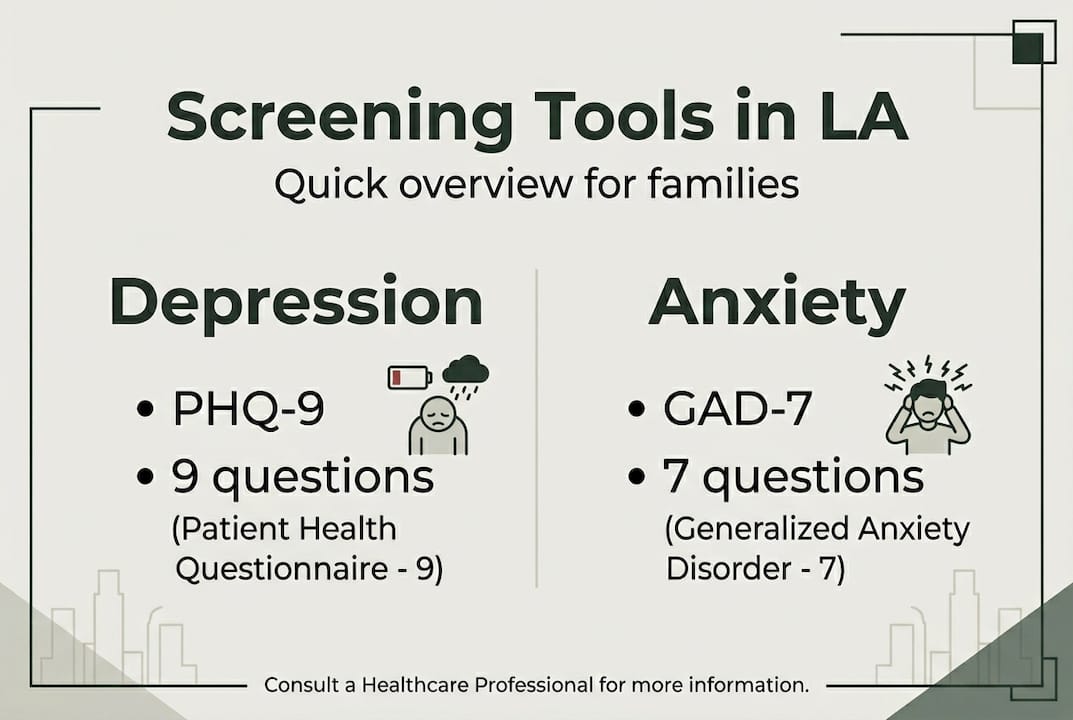
Here’s a quick overview of the most commonly used tools in LA County:
| Tool | Focus area | Number of questions | Time to complete |
|---|---|---|---|
| PHQ-9 | Depression | 9 | 2 to 3 minutes |
| GAD-7 | Anxiety | 7 | 2 minutes |
| DHCS-8765A/C | Broader MH triage | Varies | 5 to 10 minutes |
Using standardized screening tool details like these reduces the chance of bias and makes results comparable across settings. Brief, self-report formats also lower the psychological barrier to participation. People are often more willing to answer a questionnaire honestly than to describe their feelings face-to-face with a stranger.
Why does this matter locally? LA County consistently reports depression rates above national averages, partly driven by housing instability, economic stress, and the high prevalence of substance use disorders in the region. Families using LA mental health tools that are already validated and locally calibrated are better positioned to get timely, effective help.
Key features of effective mental health screening include:
- Short and accessible: Most tools take under 10 minutes to complete
- Validated: Tools like PHQ-9 and GAD-7 are backed by decades of clinical research
- Non-stigmatizing: Self-report formats create private, low-pressure environments
- Action-oriented: Scores directly inform next steps in care
How screening works: From first assessment to intervention
Now that you know the tools used, let’s see exactly how screening unfolds from start to finish and what it means for you.
Screening typically follows a clear, stepwise process. Here’s how it usually goes:
- Intake: A patient visits a clinic, recovery center, or telehealth provider for the first time.
- Screening: A brief questionnaire such as the PHQ-9 or GAD-7 is administered, either on paper or digitally.
- Scoring and interpretation: Clinicians review results against validated thresholds.
- Triage and follow-up: Based on the score, the patient is either monitored, referred for outpatient support, or escalated to a higher level of care.
Scoring thresholds matter here. PHQ-9 and GAD-7 scoring thresholds are clinically validated, with specific cutoff points that guide triage decisions. For the PHQ-9, a score of 10 or above is generally considered a positive screen for depression. For the GAD-7, a score of 10 or above indicates moderate to severe anxiety requiring follow-up.
Here’s a side-by-side view of how the two tools compare:
| Aspect | PHQ-9 | GAD-7 |
|---|---|---|
| Positive threshold | Score of 10 or above | Score of 10 or above |
| What it detects | Depression | Anxiety disorders |
| Integration | Medi-Cal, outpatient, primary care | Same settings |
| Follow-up triggered | Referral, therapy, medication eval | Counseling, further assessment |
For families navigating the system, understanding the benefits of outpatient mental health services early in the process makes it easier to accept or advocate for the right level of care. Outpatient programs, in particular, pair well with screening because they allow ongoing monitoring without pulling someone completely out of their daily life.

The USPSTF screening guidelines recommend routine screening for all adults and adolescents in primary care settings, reinforcing the idea that this isn’t just for people already in crisis. It’s preventive care.
Pro Tip: After any screening appointment, always ask the provider to explain your score in plain language and clarify exactly what happens next. You have the right to understand your results and to know which specific services or referrals are being recommended.
If you’re unsure where to start, checking outpatient benefits before your first appointment can save time and reduce confusion about coverage.
The real benefits: Early detection, outcomes, and family impact
Understanding how screening works leads us to the measurable impact it has on both individuals and families.
The evidence for early screening is strong. Research shows that screening adds 0.52 life expectancy years and 0.68 quality-adjusted life years (QALYs) when co-occurring mental health and addiction issues are identified and treated early. Those numbers represent real, tangible improvements in how long and how well people live.
Beyond individual health outcomes, screening carries financial and social benefits for families:
- Reduced absenteeism: Adults and teens who receive early treatment miss fewer days of work and school
- Lower long-term costs: Treating a condition early is almost always less expensive than managing a crisis
- Improved family relationships: Early intervention reduces the cycle of untreated mental illness straining family dynamics
- Access to specific programs: LA County programs like the Mental Health Advocacy Program (MHAP) and the recently launched Office of Transition Age Youth connect families directly to services
Speaking of youth: the LACDMH Office of Transition Age Youth was created specifically to address the needs of teens and young adults aged 16 to 25, a group especially vulnerable to both mental health disorders and substance use. Early screening is one of the primary tools this office uses to connect young people to appropriate services before issues escalate.
“Families who engage with mental health screening early are far better positioned to support recovery. Waiting until a crisis occurs is one of the most costly decisions, emotionally and financially, that a family can make.”
Pro Tip: If your teen or young adult is resistant to seeking help, consider framing screening as a routine wellness check, similar to a sports physical. Removing the clinical weight of the label can reduce resistance and encourage participation.
For families already navigating addiction alongside mental health concerns, family involvement in recovery is a well-documented factor in improving outcomes. Screening gives families a structured entry point into that process.
Barriers, stigma, and practical ways to improve access
Even with immense benefits, there are still barriers. Let’s explore these and how families can overcome them.
The most common obstacles to mental health screening in LA County include fear of judgment, concerns about confidentiality, cultural stigma, and simple confusion about where to go. Many people also worry about false positives: receiving a score that suggests a problem when they feel they are managing fine.
Here’s a realistic picture of the main barriers families report:
- Stigma: Fear of being labeled or judged, especially in communities where mental health is rarely discussed openly
- Mistrust: Concerns about how screening results will be used or shared
- False positives: Anxiety about a score triggering unwanted interventions
- Access: Not knowing where to go or which programs accept Medi-Cal
- Language and culture: Tools not always available in preferred languages or culturally adapted formats
The good news is that the evidence supports brief validated tools precisely because they reduce burden. The PHQ-9 and GAD-7 are self-administered, meaning you’re not answering questions out loud in front of a clinician. That matters for people who feel embarrassed or guarded. Many people also benefit from learning about counseling in addiction treatment along the way.
“The best screening tool is the one a person will actually complete. Brevity and privacy are features, not shortcuts.”
For teens especially, breaking screening stigma starts with honest, non-judgmental conversations at home. Parents can play a huge role simply by normalizing the idea that mental health check-ins are part of staying healthy.
If you’re looking for a deeper foundation on why this matters, the mental health recovery guide for 2026 covers the broader context of mental wellness in recovery. And for adults trying to navigate complex systems, guidance on adult mental health programs in LA County can help you understand your options without feeling overwhelmed.
A fresh perspective: What most guides miss about mental health screening
Most articles on mental health screening focus almost entirely on diagnostic accuracy: how precise the tool is, what the sensitivity and specificity numbers look like, and how clinicians interpret results. That’s useful. But it misses the bigger story. Understanding teen mental health programs can make the road ahead feel more manageable.
The real power of screening isn’t in the score itself. It’s in what happens when a community normalizes the act of checking in. When screening becomes routine, something shifts. People stop waiting until they’re in crisis. Families start talking earlier. Resources get used before they’re desperately needed.
Brief tools like the PHQ-9 and GAD-7 don’t just detect symptoms. They lower the threshold for engagement. They make it easier for someone to say, “Yes, I’ll answer a few questions,” and that small step can open a door that’s been closed for years.
At Glendora Recovery Center, we’ve seen that families who come in early, often prompted by a screening result they didn’t expect, tend to have more options and better outcomes. The conversation that follows a positive screen is where real change begins. Families become catalysts, not bystanders. That’s the shift that comprehensive recovery pathways are built on.
Connect with support: Taking the next step for your family
If this article has raised questions or confirmed something you’ve been feeling, that recognition is worth acting on. At Glendora Recovery Center, we offer mental health screening, addiction treatment, and dual diagnosis care for adults and teens throughout Los Angeles County. Our flexible programs include Partial Hospitalization, Intensive Outpatient, and telehealth options designed to fit your schedule. Whether you’re seeking help for yourself or a loved one, our team is ready to guide you through the next step with compassion and clarity. Explore our addiction treatment options, learn more about our mental health services, or contact Glendora Recovery today to speak with someone who understands.
Frequently asked questions
How do I arrange a mental health screening in Los Angeles County?
You can request screening through local health departments, clinics, or recovery centers using tools like PHQ-9 or GAD-7. LA County uses PHQ-9 and GAD-7 as standard intake tools for Medi-Cal mental health services.
What happens if my screening score is positive?
A positive score means you may be referred for further evaluation or treatment right away to prevent issues from worsening. A PHQ-9 score above 10 is considered a positive screen for depression and typically triggers a follow-up appointment.
Does screening help with addiction or co-occurring disorders?
Yes, screening identifies co-occurring mental health and addiction issues early, which improves overall care quality. Early detection through screening adds 0.52 life expectancy years and 0.68 QALYs for people with co-occurring conditions.
Is screening confidential and does it increase stigma?
Screenings are private and specifically designed to reduce stigma by using brief, self-report tools in safe environments. Brief validated self-reports remove the pressure of face-to-face disclosure, making the process more comfortable.
How does mental health screening save families money?
Screening reduces long-term treatment costs and absenteeism by identifying problems before they escalate. Programs like MHAP and the LACDMH Office of Transition Age Youth use early screening specifically to connect LA families to cost-effective, timely support.
Recommended
- Find Mental Health Help: Step-by-Step Guide for Los Angeles | Glendora Recovery Center
- Mental health resources checklist for recovery in LA | Glendora Recovery Center
- How mental health drives lasting recovery: evidence and strategies | Glendora Recovery Center
- How to find aftercare support in Los Angeles: step-by-step | Glendora Recovery Center