
TL;DR:
- Less than 1% of adolescents with substance use disorder in LA receive treatment.
- Effective teen programs include professional-led therapy, family involvement, and evidence-based approaches.
- Finding persistent, flexible, family-supported care is crucial for successful teen mental health recovery.
Only 0.5% of adolescents ages 12 to 17 with substance use disorder in Los Angeles County actually receive treatment. That number is not a typo. If your teenager is struggling with depression, anxiety, substance use, or a combination of these issues, the odds are stacked against them getting help unless you know exactly where to look and what to ask for. This guide is built for parents like you. We will explain the types of programs available across LA County, what the research says actually works, and how to access quality care without losing momentum or hope along the way.
Table of Contents
- Understanding the mental health and addiction crisis for teens in LA County
- Types of mental health programs for teens: What’s available?
- What really works: Evidence behind effective interventions
- Finding, choosing, and accessing teen mental health programs in LA County
- A hard truth: What most advice misses about teen mental health treatment
- Support for your teen: How Glendora Recovery Center can help
- Frequently asked questions
Key Takeaways
| Point | Details |
|---|---|
| Treatment gap is huge | Most LA County teens with mental health or substance issues don’t receive treatment. |
| Targeted programs work best | Professional-led and small-group interventions outperform universal efforts. |
| Integrated, family-based care matters | Co-occurring mental health and substance use issues require programs involving both teens and families. |
| Stigma and access are key barriers | Addressing privacy, motivation, and engagement hurdles boosts success. |
| Persistent advocacy pays off | Parents who stay engaged and proactive are vital to sustained teen recovery. |
Understanding the mental health and addiction crisis for teens in LA County
The scale of the problem in Los Angeles County is sobering. 17.3% of LA County residents aged 12 and older have substance use disorder, yet the share of adolescents receiving any formal treatment sits at a fraction of that figure. Behind that gap are real barriers that families run into every day: cost, stigma, long waitlists, and a system that can feel impossible to navigate.
Some teen populations carry even higher risk. Homeless youth, LGBTQ+ teens, and justice-involved adolescents face compounding stressors that raise the likelihood of both mental health disorders and substance use. For many of these young people, a single untreated issue can quickly snowball into a co-occurring disorder, meaning they are dealing with both a mental health condition and a substance use problem at the same time.
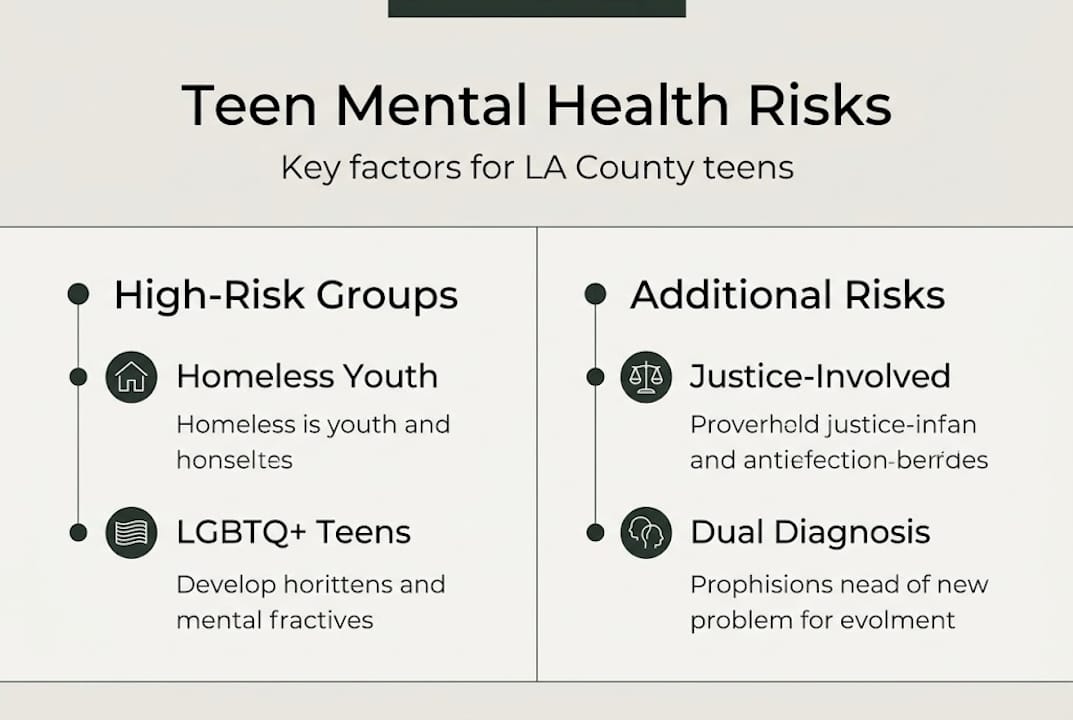
Co-occurring disorders (also called dual diagnosis) are more common in teenagers than most parents realize. A teen who starts using substances to cope with anxiety or trauma is not simply making a bad choice. That behavior reflects an unmet need. When mental health and addiction are treated separately, or when only one problem is addressed, the untreated issue tends to pull the teen back into crisis.
| Challenge | Impact on teens |
|---|---|
| Stigma around mental health | Delays help-seeking by months or years |
| Cost and insurance barriers | Limits access to private, quality care |
| Long waitlists in public systems | Increases dropout before care begins |
| Co-occurring disorders | Requires integrated treatment approach |
Key populations that need extra attention include:
- Homeless and housing-unstable youth
- LGBTQ+ teens with family rejection or bullying histories
- Teens in the juvenile justice system
- Youth aging out of foster care
“The most dangerous gap is not the one between needing help and finding a program. It is the one between finding a program and receiving truly integrated care.”
LA County has recognized this gap and launched transition age youth initiatives to address the needs of teens and young adults more holistically. Still, county programs alone cannot meet the full demand. Knowing your teen drug rehab options across both public and private providers is critical for families who want timely, effective care.
Types of mental health programs for teens: What’s available?
Parents often do not realize how many program types exist until they are deep in a crisis. Understanding your options before that moment puts you in a much stronger position.
Here are the main categories of teen mental health and addiction programs available in LA County:
- School-based prevention programs: These programs operate within middle and high schools and focus on early identification, emotional skills building, and referrals. They are widely accessible but generally limited in clinical depth.
- Outpatient therapy: Weekly or twice-weekly individual or group therapy sessions. Best suited for teens with mild to moderate symptoms who are stable enough to function at school and home.
- Intensive Outpatient Programs (IOP): Multiple sessions per week, often including group therapy, individual counseling, and family support. A strong middle-ground option for teens who need more structure without residential care.
- Partial Hospitalization Programs (PHP): Structured programming for four to six hours per day, several days a week. Learning more about partial hospitalization for teens can help you understand whether this level of care fits your teen’s current needs.
- Residential and inpatient treatment: Around-the-clock care in a live-in facility. Reserved for teens in acute crisis or those who have not responded to lower levels of care.
- Dual diagnosis or integrated care programs: Programs that treat mental health and substance use simultaneously. These are the gold standard for teens with co-occurring disorders.
| Program type | Intensity | Best for |
|---|---|---|
| School-based | Low | Prevention, early signs |
| Outpatient therapy | Low to moderate | Mild symptoms |
| Intensive Outpatient (IOP) | Moderate | Moderate symptoms, stable home |
| Partial Hospitalization (PHP) | High | Step-down from inpatient or crisis |
| Residential/inpatient | Very high | Acute crisis, severe addiction |
| Dual diagnosis (integrated) | Varies | Co-occurring disorders |
LA County’s Department of Mental Health has expanded services, including field-based teams, drop-in centers, shelter, case management, and referrals through the Office of Transition Age Youth. These public options are valuable, especially for uninsured families.
Pro Tip: When picking teen treatment, match the program intensity to your teen’s current clinical needs. Starting too low can mean slow progress; starting too high can feel overwhelming and cause dropout. A professional assessment is worth the time.
Private programs, like those offering specialized programs for teens, often provide faster access, more individualized care, and flexible scheduling that county systems cannot always match.
What really works: Evidence behind effective interventions
Not all programs are created equal, and knowing what the research says helps you cut through the marketing language and ask the right questions.

Research consistently shows that school-based mental health interventions have a small but reliable positive effect on student wellbeing. However, the data is clear that targeted programs and those led by mental health professionals outperform universal, one-size-fits-all approaches or those delivered by classroom teachers alone.
What the evidence supports for effective teen interventions:
- Professional-led treatment: Programs run by licensed therapists, counselors, and psychiatrists produce better outcomes than peer-only or teacher-delivered models.
- Family involvement: Teens whose families actively participate in treatment have significantly higher rates of completion and lower relapse rates.
- Cognitive Behavioral Therapy (CBT): One of the most studied and validated approaches for adolescent depression, anxiety, and substance use.
- Motivational interviewing: Helps resistant teens find their own reasons to engage with treatment rather than feeling forced.
- Group-based formats: When structured properly, teen group therapy builds peer support and reduces isolation, two factors strongly linked to recovery.
Mental health literacy, meaning a teen’s ability to recognize symptoms, understand treatment, and seek help, also plays a meaningful role. Mental health literacy interventions improve help-seeking behavior and reduce stigma, particularly when they are interactive and involve multiple components rather than a single classroom lesson.
Digital tools, apps, and online programs are an emerging area with real promise, especially for teens who are reluctant to attend in person. But digital interventions come with their own challenges. Engagement drops quickly if the platform does not feel relevant. Teens respond better when digital tools are paired with social connection and human support. This connects closely with counseling in addiction treatment, which covers the topic in more depth.
Parents can reinforce what professionals do in therapy by learning to support social emotional learning at home, which creates consistency between the clinical environment and daily life.
Pro Tip: Ask any program you are considering which specific therapy techniques for teens they use and whether those approaches are evidence-based. A credible program will answer this question clearly and without defensiveness.
Finding, choosing, and accessing teen mental health programs in LA County
Knowing what works is one thing. Getting your teen into the right program is another challenge entirely.
Here is a practical step-by-step approach for parents:
- Start with a professional assessment from a licensed adolescent clinician to identify diagnosis, co-occurring disorders, and appropriate level of care.
- Contact your insurance provider to confirm which programs are covered and at what level, including in-network and out-of-network options.
- Research both LA County public programs and private providers, keeping in mind that teen outpatient recovery through a private center often offers shorter wait times and more individualized scheduling.
- Visit or call at least two or three programs before deciding. Ask about staff credentials, staff-to-teen ratios, family involvement policies, and discharge planning.
- Involve your teen in the decision wherever possible, especially teens who are resistant. Feeling some ownership over the choice increases the likelihood of engagement.
Some key questions to ask any program:
- Do you treat co-occurring disorders, or only one condition at a time?
- What does family involvement look like in your program?
- How do you handle teens who are reluctant or resistant to treatment?
- What happens after the program ends? Is there aftercare planning?
Digital and in-person programs both face real barriers when stigma, privacy concerns, or low motivation are in play. Addressing these head-on is essential. Framing treatment as a strength-based process, not a punishment, helps resistant teens engage. Programs that focus on making treatment appealing for teens understand this dynamic and build it into their approach.
Parents also need support. Joining a parent support group, working with a family therapist, and learning about setting healthy boundaries are all steps that improve both your wellbeing and your teen’s recovery outcomes.
A hard truth: What most advice misses about teen mental health treatment
Here is something most articles will not tell you directly: even a clinically excellent program will struggle if the family system does not change alongside the teen. We have seen it repeatedly. A teenager completes a well-designed program, returns home, and within weeks, the same dynamics that contributed to the problem are fully back in place. Families often find it helpful to read more about teen rehab for families when planning next steps.
The other pitfall is waiting for the perfect program. Parents sometimes spend months researching every option while their teen’s situation worsens. No program is a perfect fit. What matters far more is persistence and the willingness to adjust the approach if the first choice does not work.
School counselors are valuable, but leaning on them as a primary treatment resource for a teen with a diagnosable disorder is usually not enough. This is why specialized programs matter in ways that general school support simply cannot replicate. The families who see the best outcomes are the ones who stay engaged, stay flexible, and keep showing up even when progress is slow.
Support for your teen: How Glendora Recovery Center can help
Glendora Recovery Center provides individualized mental health and addiction treatment for teens in Los Angeles County, with programs designed to meet your family exactly where you are. Our Los Angeles addiction programs include Partial Hospitalization, and our intensive outpatient for teens offers flexible scheduling including mornings, evenings, and weekends so treatment fits your teen’s life. We specialize in dual diagnosis care, family therapy, and evidence-based approaches. Our comprehensive teen mental health treatment is designed to address the whole teen, not just one symptom. Contact us today for a confidential consultation and let us help you find the right path forward.
Frequently asked questions
What types of mental health programs are available for LA County teens?
LA County offers school-based interventions, outpatient and inpatient programs, specialty services for co-occurring disorders, and transitional resources including field-based teams and drop-in centers for at-risk teens.
Are school-based mental health interventions effective?
They produce a small but reliable positive effect, and targeted professional-led programs consistently outperform universal or teacher-delivered approaches for teens with more significant needs.
How do I get my teen to engage with mental health programs?
Addressing stigma, prioritizing privacy, and emphasizing social connection all help; research shows stigma and motivation are the top barriers to engagement in both digital and in-person programs.
What should I look for in an effective teen mental health program?
Prioritize evidence-based, professionally-led programs that actively involve families and offer integrated care for co-occurring mental health and substance use disorders.
Recommended
- Find Mental Health Help: Step-by-Step Guide for Los Angeles | Glendora Recovery Center
- Why mental health screening matters: early support for LA families | Glendora Recovery Center
- Teen Addiction Recovery Steps: A Complete Los Angeles Guide | Glendora Recovery Center
- Why teens need specialized treatment: 5 key reasons | Glendora Recovery Center
- Best bereavement support options in California: 13 months free | Graceland Hospice Care Blog