
TL;DR:
- Telehealth offers flexible, remote addiction and mental health support, reducing barriers to access.
- Demographic factors like language, income, and technology access influence who benefits most from telehealth.
- Hybrid care models combining virtual and in-person services are most effective for complex recovery needs.
Many people in Los Angeles County still believe that real recovery only happens face to face. That assumption is being challenged every day. Telehealth is reshaping how adults and families access addiction treatment and mental health support across LA, and the results are more promising than most people realize. Tools like the RAND iPrevail app are showing sustained mental health improvements for county residents, yet awareness of these options remains surprisingly low. This article breaks down what telehealth really means in recovery, who benefits most, what the evidence shows, and how you can make it work for your own journey.
Table of Contents
- What telehealth means in addiction and mental health recovery
- Access and equity: who benefits and who is left out?
- Telehealth’s impact: what does the evidence say about recovery outcomes?
- Best practices: making telehealth work for your recovery journey
- Our perspective: the future of telehealth in Los Angeles recovery
- Telehealth support at Glendora Recovery Center
- Frequently asked questions
Key Takeaways
| Point | Details |
|---|---|
| Telehealth broadens access | Virtual care brings recovery support to people who may not reach in-person services, but requires tailored outreach in underserved LA populations. |
| Barriers remain for some groups | Structural challenges like language, technology, and Medicaid coverage still limit access for many in Los Angeles County. |
| Evidence shows positive results | Peer-supported telehealth programs like iPrevail are linked to symptom improvement when users engage actively. |
| Hybrid models offer flexibility | Combining telehealth with in-person care can boost outcomes, especially for families or complex cases. |
What telehealth means in addiction and mental health recovery
Telehealth is not just a video call with a therapist. In the context of addiction and mental health and recovery evidence, it refers to a broad set of tools and services delivered remotely through technology. Understanding the different forms helps you choose what fits your life.
The most common telehealth formats in recovery include:
- Video therapy sessions with licensed counselors or psychiatrists via secure platforms
- Phone-based counseling for those without reliable internet or video access
- Peer support and chat apps like the iPrevail app, offered free through LA County Department of Mental Health
- Remote monitoring tools that track mood, cravings, or medication adherence between sessions
- Text-based check-ins with care coordinators to maintain continuity between appointments
Telehealth differs from in-person care in obvious ways, but the distinction that matters most in recovery is flexibility. In-person care offers direct human contact and clinical observation. Telehealth removes geographic and scheduling barriers, making support available during a late-night craving or a stressful family moment. Hybrid care combines both, allowing someone to attend a Partial Hospitalization Program in person while using a recovery app between sessions.
In Los Angeles County, telehealth is being woven into public and private recovery programs at a growing pace. The iPrevail app, for example, pairs users with trained peer supporters and delivers cognitive behavioral therapy (CBT) modules through a smartphone. CBT is a structured therapy approach that helps people recognize and change thought patterns that fuel substance use or emotional distress.
“Telehealth in recovery is not a lesser version of care. For many people, it is the only version that fits their reality.”
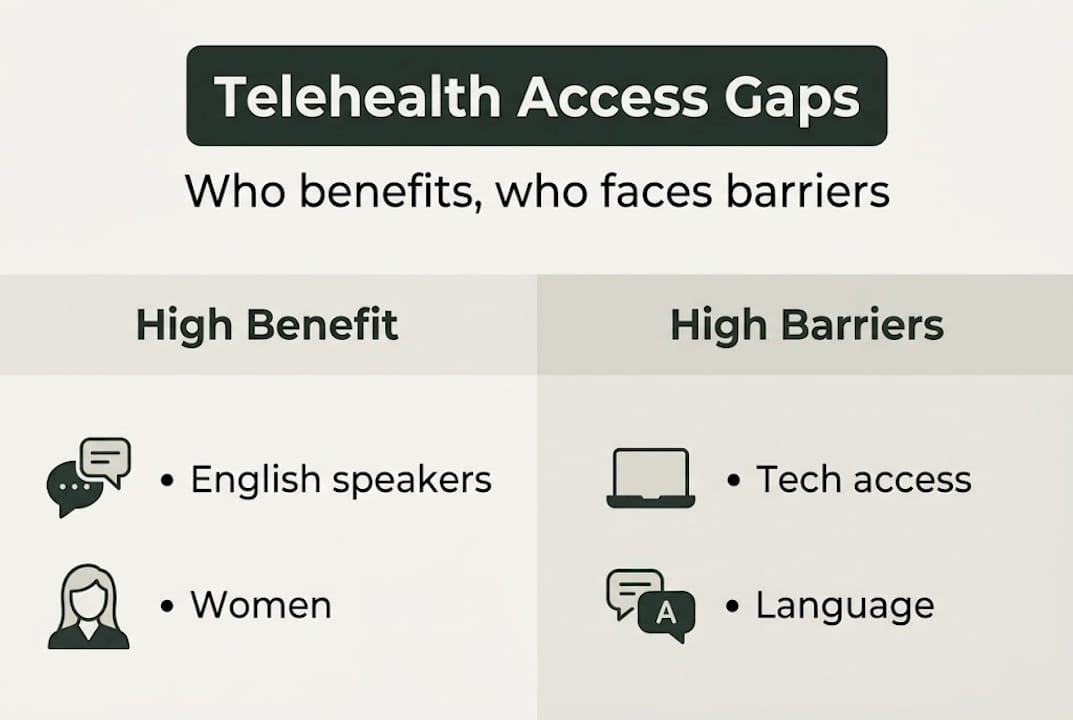
Research on who actually uses these services reveals something important. Women in South LA are significantly more likely to access telehealth than men, particularly within low-income African American and Latino communities. This tells us that demographic and social factors shape telehealth use more than personal attitude or tech confidence. Designing programs around these realities, rather than assuming equal access, is what makes telehealth genuinely useful.
Access and equity: who benefits and who is left out?
Telehealth sounds like the great equalizer. In practice, it is not quite that simple. Knowing who benefits most and who faces the steepest barriers helps you and your family navigate the landscape more effectively.
Research from Los Angeles public housing communities shows a clear pattern. Structural barriers like language, technology access, and Medicaid coverage are stronger predictors of telehealth use than a person’s attitude or self-confidence. In other words, wanting to use telehealth is not enough if you do not have a working device, a stable internet connection, or a provider who speaks your language.
| Group | Telehealth benefit level | Key barrier |
|---|---|---|
| English-speaking women | High | Few barriers |
| Low-income minority men | Moderate to low | Language, device access |
| Non-English speakers | Low | Language gap, limited bilingual providers |
| Medicaid enrollees | Variable | Coverage gaps, reimbursement issues |
| Older adults | Low to moderate | Digital literacy, device comfort |
The groups most likely to benefit from telehealth in LA County are those with reliable smartphones or computers, English language proficiency, and existing insurance or Medicaid coverage that includes virtual services. Those most likely to be left out include non-English speakers, older adults with limited digital literacy, and individuals in households without consistent internet access.
Common barriers include:
- No smartphone or computer at home
- Unreliable or unaffordable internet service
- Lack of a private space for confidential sessions
- Providers not offering services in Spanish or other languages
- Confusion about whether Medicaid covers telehealth visits
- Low awareness that free or low-cost telehealth options even exist
These gaps are not inevitable. Telehealth access policies at the state and federal level are evolving, and LA County has programs to address some of these barriers directly. Understanding mental health in recovery as a continuous need, not a one-time fix, makes closing these gaps even more urgent.
Pro Tip: If a family member is struggling to access telehealth due to technology or language barriers, contact their treatment provider directly. Many programs can connect patients with loaner devices, bilingual counselors, or tech support volunteers at no cost.
Telehealth’s impact: what does the evidence say about recovery outcomes?
With barriers and equity in mind, it is time to examine what research shows about telehealth’s true impact on recovery results.
The evidence is genuinely encouraging, though not without nuance. The RAND iPrevail app demonstrated sustained symptom improvements for LA County users who engaged with its peer chat and CBT modules, even among those with significant access barriers. The catch is that overall engagement rates were lower than hoped, meaning the people who needed it most were sometimes the least likely to keep using it.

| Outcome area | Telehealth | In-person care |
|---|---|---|
| Symptom reduction | Comparable for mild to moderate cases | Stronger for severe or complex cases |
| Treatment access | Higher, especially in underserved areas | Limited by geography and scheduling |
| Engagement consistency | Variable, lower for some groups | Generally higher with structured programs |
| Privacy and comfort | High for many users | Can feel stigmatizing for some |
| Crisis response | Limited | Stronger, immediate intervention possible |
Specific benefits for people in recovery include:
- Accessibility from home, work, or anywhere with a signal, removing the need for transportation
- Flexible scheduling that accommodates work, childcare, and other daily responsibilities
- Ongoing support between formal sessions through apps, check-ins, and peer communities
- Reduced stigma because attending a virtual session feels less visible to others
- Continuity of care when life changes make in-person attendance temporarily impossible
For aftercare in recovery, telehealth is particularly valuable. Maintaining connection to support after completing a structured program is one of the strongest predictors of long-term sobriety. Virtual check-ins and peer apps make that connection far easier to sustain. If you are exploring online mental health treatment, understanding these outcomes helps set realistic expectations.
“The goal is not to replace human connection in recovery. It is to make sure that connection is never more than a screen away.”
Best practices: making telehealth work for your recovery journey
Knowing the evidence and challenges, let’s focus on how you can personally make telehealth an effective piece of your recovery strategy.
The first step is identifying what you actually need. Someone in early recovery from alcohol use disorder has different needs than someone managing anxiety alongside a history of opioid dependence. Be honest with yourself and your provider about your goals, your living situation, and your comfort with technology.
Here are steps to combine telehealth and in-person care for a flexible recovery plan:
- Start with a clinical assessment, either in person or via video, to determine the right level of care
- Ask your provider about hybrid options that blend structured in-person sessions with virtual check-ins
- Download and explore free county resources like the iPrevail app as a supplement, not a replacement
- Set a consistent schedule for virtual sessions, treating them with the same seriousness as in-person appointments
- Identify a private, quiet space in your home for telehealth sessions to protect your focus and confidentiality
- Loop in a trusted family member who can help troubleshoot technology or provide accountability
Experts recommend hybrid care models for families or individuals with complex mental health and addiction needs in LA. Ongoing policy work around Medicaid reimbursement is also needed to make these models financially sustainable for more people. Exploring outpatient mental health services and reviewing your addiction treatment options are smart starting points.
Pro Tip: Ask your treatment provider specifically whether their telehealth platform is HIPAA-compliant and whether sessions can be recorded for personal review. Knowing your privacy is protected makes it easier to open up during virtual sessions.
Our perspective: the future of telehealth in Los Angeles recovery
At Glendora Recovery Center, we have watched telehealth evolve from a pandemic workaround into a genuine pillar of recovery care. Our honest take is this: technology alone does not drive lasting recovery. People do.
The apps, the video platforms, and the remote monitoring tools are only as effective as the human relationships built around them. What we see missing in many telehealth conversations is the emphasis on personalized outreach, especially for communities that have historically been underserved by the mental health system. Policy changes and digital literacy efforts, not just newer apps, are what will actually move the needle for low-income and minority residents in LA County.
We also believe the contrarian point needs to be said clearly: more technology is not always better. A person in a chaotic home environment may struggle to engage with a telehealth session in ways that have nothing to do with motivation. Hybrid models that pair virtual flexibility with real human touchpoints are, in our experience, the most effective approach for complex cases. The mental health recovery evidence supports this. What we hope to see in LA County is sustained investment in outreach, bilingual care, and Medicaid policy reform that makes hybrid recovery genuinely accessible to everyone who needs it.
Telehealth support at Glendora Recovery Center
If you are ready to explore telehealth or blended care for your own recovery, Glendora Recovery Center is here to help. We offer flexible virtual and hybrid treatment options designed for adults and families across Los Angeles County, including morning, evening, and weekend sessions that fit around your real life. Our team specializes in addiction treatment, dual diagnosis care, and family support using a compassionate, individualized approach.
Whether you are just starting to explore your options or looking to transition from a current program, we can walk you through our addiction treatment options and mental health care services. Reach out today. You do not have to figure this out alone.
Frequently asked questions
What telehealth services are available for addiction recovery in Los Angeles?
Telehealth services in LA include video therapy, phone counseling, recovery apps like iPrevail via LA County DMH, and remote peer support, often provided through county partnerships or local treatment centers.
Are telehealth services as effective as in-person addiction or mental health care?
Research shows telehealth can support sustained recovery improvements, though iPrevail showed lower engagement overall despite positive symptom outcomes, meaning effectiveness varies by individual and circumstance.
Who is most likely to use telehealth in LA County recovery programs?
Women, English speakers, and those with reliable technology access use telehealth most, while gender and language factors create persistent gaps for low-income and non-English-speaking residents.
What can families do to help loved ones access telehealth for recovery?
Families can assist by helping troubleshoot devices, connecting with bilingual providers, and navigating Medicaid and access barriers that often prevent low-income individuals from using available telehealth services.
Recommended
- How mental health drives lasting recovery: evidence and strategies | Glendora Recovery Center
- How Outpatient Treatment Centers Fuel Long-Term Recovery
- Why Ongoing Recovery Matters in Addiction Treatment | Glendora Recovery Center
- Addiction Treatment Options 2025: Complete Guide | Glendora Recovery Center
- Acendify – Your AI Mental Wellness Coach | 24/7 Support for Stress & Anxiety