
TL;DR:
- Intensive outpatient programs offer flexible, structured addiction treatment without overnight stays.
- IOPs are effective, affordable, and support long-term recovery while maintaining daily responsibilities.
- Suitable for those with stable homes, completed detox, and motivated to engage in treatment.
Many people believe that overcoming addiction means stepping away from everything: your job, your family, your daily routine. That belief keeps a lot of people from seeking help at all. Intensive outpatient programs (IOPs) challenge that assumption directly. They offer structured, evidence-based treatment that fits around your real life, not the other way around. For adults and teens across Los Angeles County, IOPs represent a clinically sound path to recovery that does not require checking into a facility around the clock. This article breaks down what IOPs are, why they work, and how to know if one is the right fit for you or someone you care about.
Table of Contents
- What is an intensive outpatient program (IOP)?
- Key benefits of choosing intensive outpatient for recovery
- How effective is intensive outpatient care?
- Is intensive outpatient right for you or your teen?
- The truth about choosing IOP: What most people don’t realize
- Ready to learn more or start your IOP journey?
- Frequently asked questions
Key Takeaways
| Point | Details |
|---|---|
| Flexible treatment | Intensive outpatient programs allow you to recover while continuing work, school, or family responsibilities. |
| Cost-effective | IOPs cost significantly less than inpatient care and are often covered by insurance plans. |
| High success rates | With 50-70% abstinence rates, IOPs are as effective as many inpatient programs. |
| Local accessibility | IOPs are readily available for adults and teens across Los Angeles County. |
What is an intensive outpatient program (IOP)?
Now that we have challenged the old-school view of addiction recovery, let us clarify what an intensive outpatient program actually offers.
An IOP is a structured form of addiction treatment that provides regular, scheduled therapy sessions without requiring overnight stays. Patients attend treatment several times per week while continuing to live at home. The goal is to deliver meaningful clinical care, including group therapy, individual counseling, and skills-based education, while allowing participants to maintain their responsibilities outside of treatment.
Most IOPs run three to five days per week, with sessions lasting two to four hours each day. That adds up to roughly nine to twenty hours of treatment per week, which is a significant clinical commitment. Sessions typically include group therapy, one-on-one counseling, relapse prevention planning, and psychoeducation on topics like coping strategies and managing triggers.
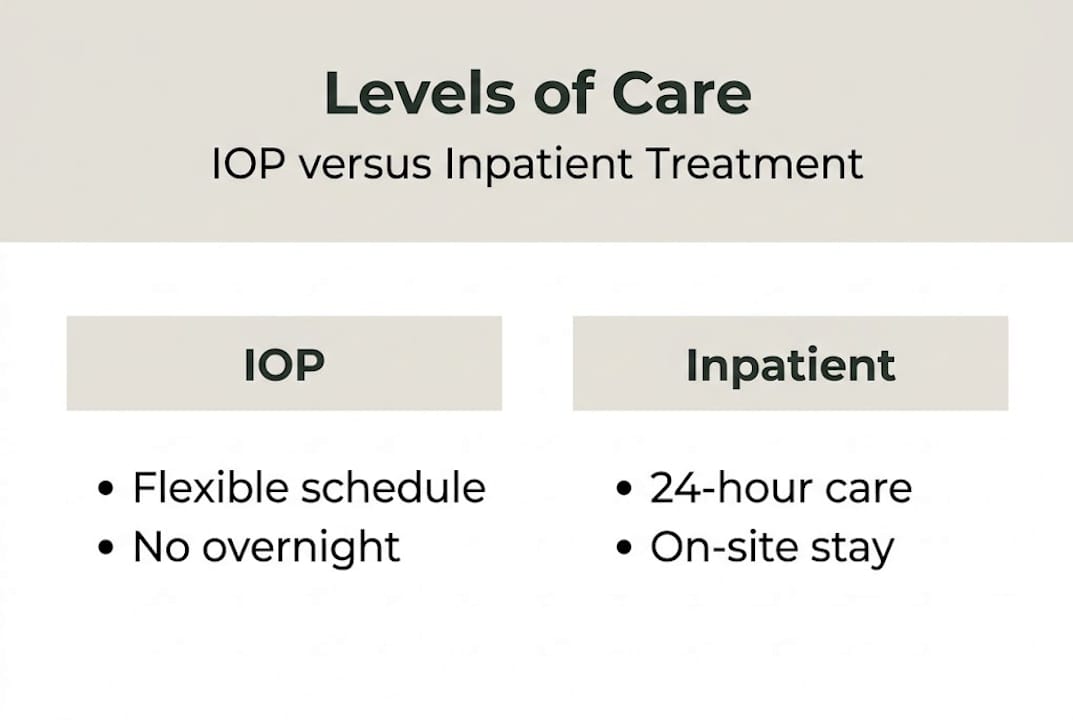
Understanding the IOP basics and benefits helps clarify how this level of care sits between standard outpatient and inpatient treatment. Here is a quick comparison:
| Level of care | Overnight stay | Weekly hours | Best for |
|---|---|---|---|
| Inpatient/residential | Yes | 40+ | Severe addiction, medical needs |
| Partial hospitalization | No | 20-30 | Step-down from inpatient |
| Intensive outpatient | No | 9-20 | Stable home, moderate needs |
| Standard outpatient | No | 1-3 | Mild symptoms, maintenance |
As this comparison shows, IOPs are structured but more flexible than inpatient rehab, making them a practical option for people who need real support without full residential care.
Who benefits most from an IOP? Generally, good candidates include:
- Adults and teens who have completed detox and need continued support
- People with a stable, substance-free home environment
- Individuals who cannot take extended time away from work, school, or family
- Those stepping down from inpatient or partial hospitalization programs
- Anyone seeking a structured program without 24/7 supervision
For those wondering who IOP is for, the answer is broader than most people expect. Across Los Angeles County, IOPs serve a wide range of people, from working professionals to high school students, all receiving individualized care within a flexible framework.
Key benefits of choosing intensive outpatient for recovery
Understanding the basics sets the stage for seeing the real-life benefits of choosing an IOP for your recovery.
One of the most practical advantages of an IOP is that it does not ask you to put your life on hold. IOPs help people keep up with family, work, and school responsibilities, which matters enormously for long-term success. Recovery that integrates with real life tends to stick better than recovery that isolates you from it.
Flexibility is built into how IOPs are scheduled. Many programs, including those in the Los Angeles area, offer morning, evening, and weekend sessions. Evening tracks are especially valuable for people who work standard business hours or teens attending school during the day. This scheduling flexibility removes one of the most common barriers to starting treatment.

Cost is another major factor. IOPs are often more affordable, with costs ranging from $3,000 to $10,000, compared to inpatient programs that can run $20,000 or more for a 30-day stay. Most insurance plans, including Medi-Cal and many private insurers, cover IOP services to some degree. That makes access far more realistic for a wider range of families.
Here is a snapshot of how IOP compares financially:
| Treatment type | Estimated cost | Insurance coverage | Disruption to daily life |
|---|---|---|---|
| Inpatient (30 days) | $20,000-$60,000 | Partial to full | High |
| Intensive outpatient | $3,000-$10,000 | Often covered | Low |
| Standard outpatient | $1,000-$5,000 | Usually covered | Minimal |
Beyond cost and scheduling, IOPs provide a therapeutic community. Peer group sessions create accountability and connection, which are two things that strongly support sustained recovery. You are not going through this alone, and you are not disappearing from your life to do it.
For a fuller picture of what outpatient recovery benefits look like in practice, it helps to read about real program structures and what all about IOPs covers in terms of clinical components.
Pro Tip: Before committing to any program, call the admissions team and ask specifically about your insurance coverage. Many centers will verify your benefits at no cost and walk you through what is covered before you make any decisions.
How effective is intensive outpatient care?
A common concern is whether IOPs can deliver results comparable to more intensive, live-in programs.
The short answer is yes. Research consistently shows that IOPs produce outcomes similar to inpatient treatment for many people with substance use disorder. IOP success rates are 50 to 70% sustained abstinence at 3 to 18 months, which is directly comparable to inpatient and residential programs. That is a significant finding that challenges the widespread assumption that only full-time residential care can produce lasting results.
“The evidence base for intensive outpatient programs has grown substantially. For appropriate candidates, outcomes match those of residential treatment, with the added benefit of real-world skill application during treatment itself.”
Several factors influence how well an IOP works for any individual:
- Home environment stability: Living in a safe, supportive, substance-free home significantly improves outcomes.
- Personal commitment: Attendance, engagement in therapy, and willingness to practice new coping skills all play a role.
- Program quality: Accredited programs with licensed clinicians and evidence-based therapies produce better results.
- Dual diagnosis support: Programs that address co-occurring mental health conditions alongside addiction tend to have stronger long-term outcomes.
- Aftercare planning: Transitioning into ongoing support, such as alumni groups or continued counseling, extends the gains made in IOP.
For adults and teens in Los Angeles County, the ability to explore IOP outcomes in detail can help set realistic expectations. The data supports IOPs as a legitimate, effective treatment path, not a lesser substitute for inpatient care.
If you want to understand why choose IOP in LA, the effectiveness data is a strong starting point. Combined with the flexibility and affordability covered earlier, the clinical case for IOPs is clear.
Is intensive outpatient right for you or your teen?
Knowing IOPs are both effective and flexible, the next step is figuring out if you or your loved one fit the profile for this level of care.
IOPs work for people with a stable home and without need for 24/7 supervision; teens ages 9 to 17 and working adults are often ideal candidates. But there are more specific factors worth evaluating before making a decision.
You or your teen may be a strong IOP candidate if:
- You have completed medical detox and no longer need around-the-clock monitoring
- Your home environment is stable and free from active substance use
- You are motivated to engage in treatment while maintaining daily routines
- You have a reliable way to get to and from sessions
- You do not have a co-occurring medical condition requiring constant supervision
- You are a teen with family support and a structured school schedule
For teens specifically, family involvement is a core part of effective IOP treatment. Programs designed for adolescents in Los Angeles County often include family therapy sessions, school coordination, and age-appropriate group therapy. The evening IOP flexibility available at many centers makes participation possible even during the school year.
There are also situations where a higher level of care is more appropriate. If someone is experiencing active withdrawal, has a history of severe relapse, or is in a living situation with ongoing substance use, partial hospitalization or inpatient treatment may be a better starting point. The goal is always to match the level of care to the individual’s actual needs.
When you are ready to assess your specific situation, reviewing what makes someone a fit for IOP and how to choose the right IOP can make the process less overwhelming.
Pro Tip: Schedule a free consultation with an admissions counselor before deciding on any level of care. A brief conversation about your history, home situation, and goals can clarify which program is the right fit from the start.
The truth about choosing IOP: What most people don’t realize
Here is something we see consistently at Glendora Recovery Center: most people who hesitate before starting an IOP are not waiting because they are not ready. They are waiting because they believe they need to be more ready. They think recovery has to look a certain way, usually a dramatic break from everything, before it can count as real.
That belief delays treatment far more than any logistical barrier does. We have worked with clients who were managing full-time jobs, raising children, and attending college while making genuine, measurable progress in their IOP. Recovery does not require total isolation. For many people, staying connected to their life is what gives recovery its meaning.
The other thing people underestimate is how much the structure of an IOP itself builds momentum. Showing up three to five times a week, engaging with a group, and applying new skills in real time creates a rhythm that supports change. You do not have to wait for the perfect moment. Understanding why choose IOP now often comes down to recognizing that the right time is sooner than you think.
Ready to learn more or start your IOP journey?
If you are ready to take the next step or just need more information about IOPs, Glendora Recovery Center is here to help. We serve adults and teens across Los Angeles County with flexible, individualized treatment options that fit real lives. Our admissions team can answer your questions, verify your insurance, and walk you through all available treatment options in Los Angeles at no cost to you. Whether you are exploring options for yourself or a loved one, we make it easy to get clear answers fast. Learn more about how our programs work by visiting our page on outpatient rehab programs or find out specifically why choose our IOP at our Glendora facility.
Frequently asked questions
How much does an intensive outpatient program cost in Los Angeles?
IOP programs in LA typically range from $3,000 to $10,000 and are often covered fully or partially by insurance, including many private plans and Medi-Cal.
Who is eligible for intensive outpatient in LA County?
IOPs are best suited for teens and adults who have a stable home environment, have completed detox if needed, and do not require 24/7 supervision. Evening and weekend options make them accessible for working adults and students.
Are IOPs as effective as inpatient rehab?
Research shows IOPs achieve 50 to 70% abstinence at three to eighteen month follow-ups, which is comparable to inpatient and residential treatment outcomes for appropriate candidates.
What’s the difference between IOP and partial hospitalization?
IOPs typically run two to four hours per day, a few days per week, while partial hospitalization programs involve near full-day sessions, usually five to six hours, without overnight stays, making them more appropriate for people stepping down from inpatient care.